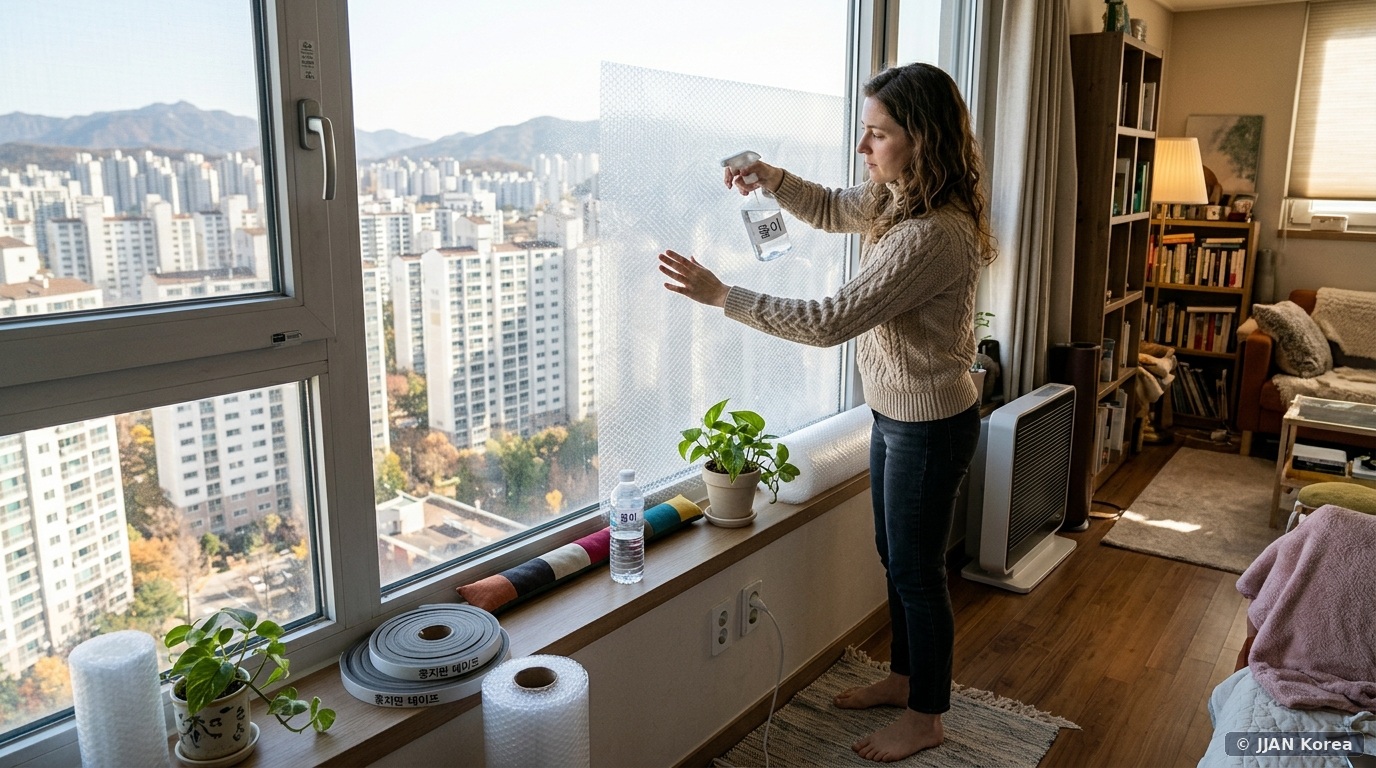
As late October arrives, South Korea’s crisp autumn breezes begin a sharp transition toward the sub-zero Siberian cold fronts of winter. For international residents living in typical Korean rental accommodations—whether compact studio one-rooms (Won-rum), multi-family residential villas, or older officetels—the arrival of sub-zero temperatures brings an unpleasant architectural surprise: severe thermal drafts (Chan-baram – 찬바람), massive heat loss through single-pane aluminum windows, and astronomical winter gas heating bills. More dangerously, sudden sub-zero polar plunges can trigger catastrophic frozen and burst water pipes (Dong-pa – 동파), leaving tenants without running water and liable for millions of won in plumbing repairs. Fortunately, Korean tenants have perfected ingenious, inexpensive DIY home winterization techniques centered around thermal window bubble wrap (Bbok-bbok-i), silicone draft gaskets, and strategic boiler programming.
1. The Bbok-bbok-i Phenomenon: Why Bubble Wrap on Windows Works
Walk down any residential Korean neighborhood in November and you will notice something peculiar: virtually every apartment window is covered in transparent plastic bubble wrap. Known affectionately across South Korea by the onomatopoeic name Bbok-bbok-i (뽁뽁이)—mimicking the popping sound of bursting bubbles—this humble packaging material is officially recognized by the Korea Institute of Civil Engineering and Building Technology as a legitimate thermal insulation marvel.
| Insulation Measure | Application Area | Indoor Temperature Impact | Estimated Monthly Heating Gas Savings |
|---|---|---|---|
| Window Bubble Wrap (단열 뽁뽁이) | Single or double-pane window glass | Raises room temp by +2.5°C to +3.5°C | 15% ~ 20% Reduction |
| Door Draft Sweep Gaskets (Munjolli) | Front door & veranda bottom threshold gaps | Blocks sub-zero corridor drafts | 5% ~ 8% Reduction |
| Padded Thermal Floor Rugs (Ka-pet) | Laminate floor above heated ondol pipes | Retains radiant heat 3x longer | 10% Reduction |
| Indoor Winter Camping Tents (Nanbang Tent) | Pitched directly over mattress on bed | Traps body heat; interior +4°C warmer | Enables setting boiler to low 18°C |
The science is simple: the sealed air pockets inside the bubbles create an immobile dead-air buffer zone between the freezing outdoor glass surface and the warm indoor room, reducing convective heat loss by over 30%. Best of all, applying it requires zero glue, tape, or nails: simply spray clean water onto the window glass with a spray bottle and press the flat side of the bubble wrap against the glass; surface tension holds it firmly in place all winter long without damaging rental property surfaces!
2. Step-by-Step DIY Sealing Guide: Daiso Supplies Under 15,000 Won
You don’t need expensive contractors to winterize your apartment. By purchasing 3,000-won window insulation sheets and door draft tapes at Daiso, you can completely insulate a standard studio for less than 15,000 KRW:
- Step 1: Clean the Glass: Wipe interior window panes with a microfiber cloth and rubbing alcohol to remove grease and dust.
- Step 2: Spray Water Generously: Mist the glass thoroughly with clean tap water (adding one drop of dish soap enhances adhesion).
- Step 3: Apply the Bubble Wrap: Cut the bubble sheet to match window dimensions with scissors. Press the smooth side against the wet glass, smoothing out air bubbles from center to edges with your palms.
- Step 4: Seal Window Gaps with Weatherstripping Tape (Mungyeol-teum-sae Tape): Apply adhesive foam or silicone draft tape along the sliding seams where window sashes meet to block howling drafts.
- Step 5: Install Front Door Bottom Draft Sweeps: Older apartment metal entrance doors have wide gaps at the bottom threshold. Slide a foam draft tube or stick a silicone draft sweep along the bottom edge to block frigid hallway air.
3. Preventing Catastrophic Frozen Pipes (Dong-pa – 동파)
When temperatures plunge below -10°C for consecutive nights, the greatest architectural catastrophe in Korean rentals is Dong-pa (동파 / Frozen and Burst Water Pipes). Under standard Korean lease law, if pipes freeze due to tenant negligence (e.g., leaving the boiler turned completely off during a winter holiday), the tenant is legally responsible for all plumbing repair bills and downstream water damage to neighboring units!
To guarantee your pipes never freeze, execute these two non-negotiable rules:
First, by switching your digital boiler to out-of-office (외출) mode to prevent pipe bursts, NEVER turn your digital boiler master power switch off when leaving your apartment! Set the boiler to “Out of Office” (Wae-chul – 외출) mode. In this mode, the boiler maintains a low circulating water temperature (around 10°C to 12°C) inside the underfloor pipes, firing automatically if temperatures drop toward freezing.
Second, during severe cold snaps (Han-pa Gyeong-bo), leave your bathroom sink faucet turned slightly toward the HOT water side, dripping a steady stream of water about as thick as a pencil lead. Moving water cannot easily freeze, and keeping the hot water circuit dripping ensures the boiler’s delicate heat-exchanger intake pipes remain clear.
4. Sliding Sash Weatherstripping (Pung-ji-pan) & Ondol Thermostat Calibration
While applying insulating bubble wrap (Bbok-bbok-i) onto window panes eliminates conductive glass heat loss, a major source of creeping drafts in Korean villas and high-rise apartments is infiltration through window sashes. Most Korean residential windows are dual-sliding double-pane assemblies designed with built-in drainage weep holes at the bottom of the aluminum or PVC tracks to prevent rainwater accumulation during summer monsoons. In October and November, freezing Siberian winds enter through these weep holes and track gaps, creating noticeable floor drafts.
To eliminate these drafts, purchase two specialized Daiso sealing accessories: Weep Hole Mesh Bug & Draft Stickers (Bangguchung Bangchung-mang) and Rubber Track Wind Blockers (Pung-ji-pan – 풍지판). Pungjipan are molded flexible rubber blocks shaped to fit into the interlocking corners where sliding window sashes meet the upper and lower frames. By peeling the self-adhesive backing and pressing them firmly into the sash corners, you eliminate draft airflow while preserving your ability to slide the window open for ventilation.
Simultaneously, calibrate your wall-mounted digital Ondol floor heating thermostat (Boiler Jojeolgi). The most common mistake newcomers make is leaving the heating mode set to “Room Temperature” (Sil-nae – 실내) in drafty rooms. In this mode, the wall sensor measures ambient air temperature; if a slight window draft blows past the sensor, the boiler fires continuously at maximum power, driving monthly gas bills past 250,000 KRW!
Instead, switch the thermostat mode to “Heating Water Temperature” (On-su / Nan-bang-su – 난방수). This setting directly regulates the temperature of the water circulating through the radiant PEX piping under your floorboards. Setting Nanbangsu to 50°C to 55°C maintains gentle, consistent floor warmth across all rooms regardless of exterior air currents, slashing your winter heating energy consumption by 20% to 35%.
For external veranda utility spaces housing your washing machine and water supply hoses, purchase foam pipe insulation tubes (Bo-on-jae – 보온재) from Daiso for 1,000 KRW per meter. Slit the foam tubes lengthwise, wrap them around exposed copper and PVC water pipes, and secure them with vinyl tape to prevent catastrophic pipe bursts during sudden sub-zero cold snaps.
4. Frequently Asked Questions (FAQ)
Q1: Will removing bubble wrap in the spring leave sticky residue or peel window tint?
No! Because genuine thermal window bubble wrap adheres purely through the surface tension of sprayed water, removing it in April takes literally two seconds: simply pull the corner and peel it off. The glass remains pristine with zero sticky adhesive residue.
Q2: What is an indoor “Nanbang Tent” and does it actually work?
An indoor heating tent (Nanbang Tent – 난방텐트) is a bottomless fabric tent pitched directly over your bed mattress. Manufactured with high-density polyester that blocks drafts while remaining breathable, your natural body heat and breathing warm the interior by 4°C to 5°C within 15 minutes, allowing you to sleep in total warmth while keeping room boiler settings low.
Q3: How do I thaw pipes if my water is already frozen in the morning?
If you turn on the faucet and zero water flows, locate the boiler unit (usually in the veranda or utility closet). The bottom two pipes are the cold water inlet and hot water supply pipes. Wrap the frozen pipe sections in thick hand towels and apply gentle warmth using a hairdryer on medium heat, or pour warm water (under 50°C) over the towels. NEVER use boiling water or an open flame, which causes instantaneous thermal shock that shatters metal and PVC pipes!
Q4: Why does moisture and mold (Gompangi) form on insulated windows?
In small Korean studios, high indoor humidity from cooking, showering, and drying laundry hits the cold window frames, creating condensation. To prevent black toxic mold, open your windows for 5 minutes twice daily to ventilate, and wipe down window sills with a diluted bleach solution once a week.
🛡️ JJAN Korea Editorial Standards & Fact-Checking Verification
This apartment winterization and energy efficiency guide has been authored and verified by Tech & Systems Editor Min-jun Kim in coordination with building maintenance guidelines published by the Korea Energy Agency (KEA) and the Seoul Metropolitan Waterworks Authority (Arisu).
- Thermal efficiency test data for window bubble wrap cross-checked against Korea Institute of Civil Engineering standards.
- Frozen pipe tenant liability rules audited under Article 623 of the Korean Civil Act (Landlord and Tenant Repair Obligations).
- Boiler energy preservation settings confirmed with Rinnai, Navien, and Kiturami technical operational manuals.