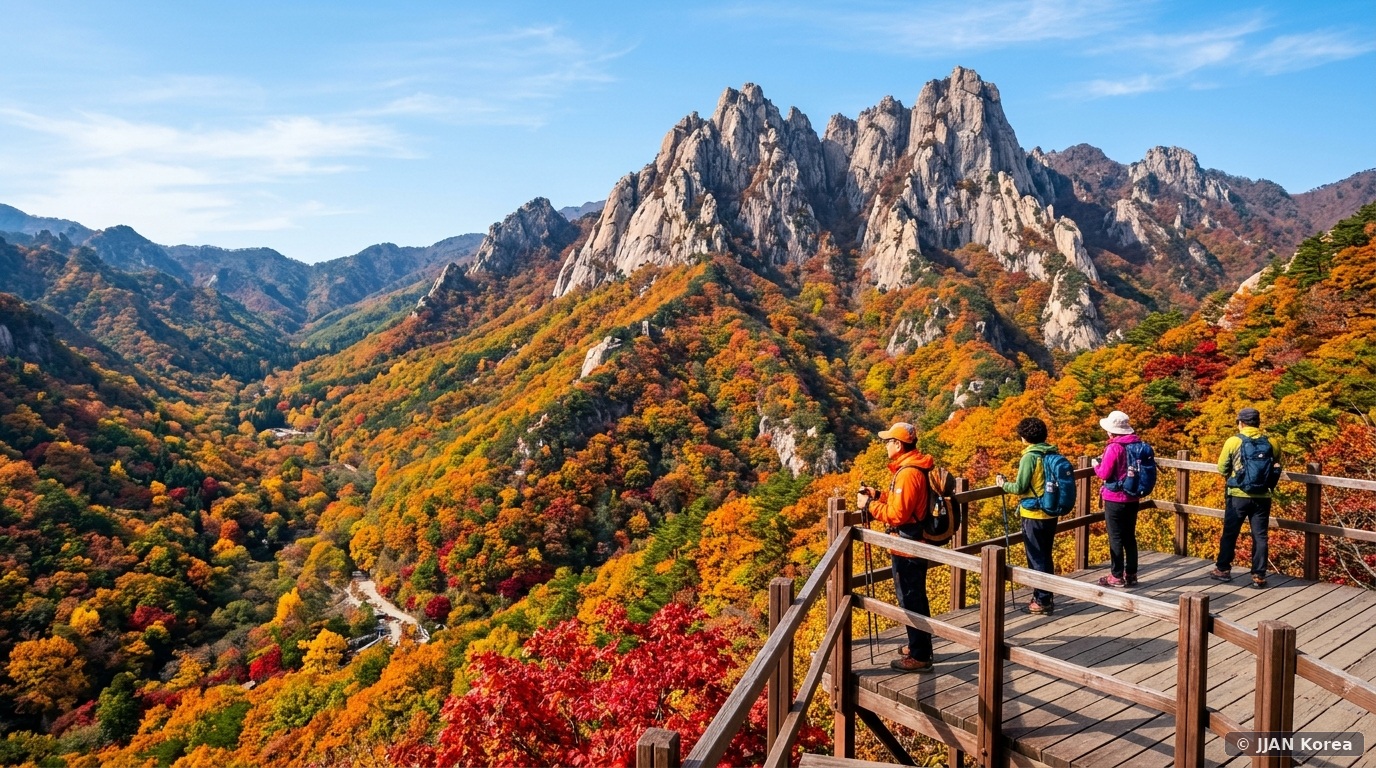
Every year in late September, an extraordinary natural transformation begins at the highest jagged granite crests of Seoraksan National Park (설악산국립공원) in Gangwon Province. As arctic high-pressure systems push cold nocturnal air into the Korean Peninsula, the third-highest mountain peak in South Korea (Daecheongbong Peak – 1,708 meters) is the very first geographical location in the entire country where deciduous leaves begin their autumn transition. Over the subsequent three weeks, a glorious wave of brilliant crimson maples (Danpung – 단풍), burning amber oaks, and luminous golden ginkgo trees cascades downward through dramatic glacial valleys, sheer granite spires, and crystal-clear mountain cascades. For alpine trekkers and autumn leaf chasers, experiencing peak foliage along Seoraksan’s legendary trails represents the holy grail of Korean outdoor adventure.
1. The 2026 Danpung Forecast: First Leaves vs. Peak Foliage Windows
The Korean Forest Service (KFS) and Korea Meteorological Administration (KMA) define autumn leaf transitions using two precise scientific benchmarks: the “First Foliage” (Cheot-danpung – 첫단풍), marked when 20% of the mountain summit turns color, and “Peak Foliage” (Jeoljeong – 절정), marked when 80% of the entire mountain canopy is ablaze with vibrant hues.
| Seoraksan Elevation Zone | Altitude (Meters) | Estimated First Leaf Transition | Estimated Peak Crimson Window |
|---|---|---|---|
| High Summit Ridge (Daecheongbong) | 1,400m ~ 1,708m | September 26 ~ September 29 | October 6 ~ October 12 |
| Upper Valleys (Cheonbuldong / Dinosaur Ridge) | 800m ~ 1,300m | October 2 ~ October 6 | October 14 ~ October 20 |
| Lower Basin & Sogongwon Temple Area | 200m ~ 700m | October 8 ~ October 14 | October 21 ~ October 28 (Most Accessible) |
| Southern Seoraksan (Osaek Valley & Mineral Spring) | 350m ~ 900m | October 5 ~ October 10 | October 18 ~ October 25 |
Because mountain summit temperatures drop rapidly in late September, ensuring that you are properly dressed is critical for survival. By wearing warm thermal layers and windbreakers for high-altitude mountain winds, hikers protect against hypothermia while ascending windy ridgelines.
2. The Top Three Autumn Foliage Trails: From Gentle Walks to Alpine Challenges
Seoraksan is divided into Outer Seoraksan (Oe-seorak), Inner Seoraksan (Nae-seorak), and Southern Seoraksan (Nam-seorak). Selecting the trail matching your physical fitness level ensures an unforgettable experience:
- Trail 1: Cheonbuldong Valley (천불동계곡) – The Golden Standard (Intermediate): Starting from the Sogongwon Visitor Center, this 7-kilometer trail follows a pristine mountain stream beneath towering cathedral-like granite pillars named the “Valley of a Thousand Buddhas.” Elevated steel boardwalks wind past emerald plunge pools (Biseondae Rock) and dramatic thundering waterfalls (Oryeon and Yangpok Falls) entirely enveloped in blazing scarlet maples. Round-trip: 5 to 6 hours.
- Trail 2: Ulsanbawi Rock (울산바위) – The Panoramic Monument (Challenging): A 3.8-kilometer steep ascent terminating at a colossal 800-meter-wide granite cliff composed of six giant jagged peaks. The final 800-stair vertical metal staircase challenge rewards hikers with a breathtaking 360-degree panoramic view stretching from the golden canopy of Seoraksan all the way east to the deep blue East Sea (Donghae) coastline of Sokcho. Round-trip: 4 hours.
- Trail 3: Biryong Waterfall & Towangseong Observatory (Family / Moderate): A gentle, shaded 2.8-kilometer forest trail crossing picturesque suspension bridges to Biryong (Flying Dragon) Falls, followed by a steep 900-stair ascent to the high observation deck overlooking the colossal, 320-meter three-tiered Towangseong Falls pouring through the autumn forest. Round-trip: 2.5 to 3 hours.
3. The Cable Car Alternative: Sogongwon to Gwongeumseong Fortress
If you are traveling with young children, elderly parents, or lack heavy trekking boots, you don’t need to conquer grueling mountain trails to witness the autumn splendor. By riding the Sogongwon cable car during vibrant autumn foliage season, the Swiss-engineered aerial tramway whisks visitors 1,200 meters across the canyon in just 5 minutes to the high mountain plateau of Gwongeumseong Fortress.
From the upper cable car station, an easy 10-minute walk up smooth rock steps leads to the bare granite summit of Bonghwadae. Standing atop this natural stone aerie surrounded by twisting thousand-year-old bonsai-like Korean red pines provides majestic views overlooking Outer Seoraksan without physical exhaustion. (Pro tip: Cable car tickets are sold exclusively in-person on a first-come, first-served basis on the day of travel; arrive by 07:30 AM during peak October weekends to secure morning boarding slots).
4. Southern Seoraksan: Osaek Mineral Springs & Jujeongol Gorge
For connoisseurs seeking uncrowded, poetic tranquility, enter Seoraksan via its southern gate in Yangyang: Jujeongol Gorge (주전골) in Southern Seoraksan (Osaek). This gentle valley features flat, barrier-free wooden boardwalks meandering beside turquoise mineral streams, surrounded by bizarre sculpted rock formations and vivid crimson foliage.
The trail begins at the famous Osaek Mineral Spring (오색약수), a natural cold spring bubbling up through riverbed granite. Rich in natural iron, carbonic acid, and minerals, the effervescent water has a distinct tangy, iron-rich flavor celebrated in traditional Korean medicine for revitalizing stomach digestion and circulation. After completing your foliage walk, soak in the restorative waters of the nearby Osaek Carbonated Hot Spring spas (Osaek Oncheon) to melt away muscle fatigue.
5. Alpine Autumn Safety & Sokcho Coastal Heritage Detours
Autumn trekking in high-altitude national parks requires heightened ecological awareness. Late September and October coincide with hyperactive foraging periods for Korean wildlife preparing for winter hibernation. While encounters with native Asiatic black bears (Bandaldaseumgom) are exceptionally rare in Outer Seoraksan, autumn hikers must watch out for Asian giant hornets (Jangsu-malbeol) nesting in leaf litter. Never wear dark black or dark brown clothing on trails (which hornets associate with predators like bears); wear bright white, beige, or red apparel, and never swat aggressively if a hornet approaches.
If you have extra energy after completing your morning mountain hike, catch a 20-minute bus into coastal Sokcho to visit Abai Village (아바이마을). Founded by North Korean refugees from Hamgyeong Province who fled south during the Korean War, this historic fishing village is reached via a charming hand-pulled wooden ferry raft (Gaetbae – 갯배). Savoring authentic Abai Sundae (steamed pork sausage packed with sweet rice and winter vegetables) while looking back at the rugged granite silhouette of Seoraksan glowing orange in the sunset completes an extraordinary day.
Mountain Hydration and Fuel Strategies: Because mountain ridges in Seoraksan experience dry, biting winds that accelerate fluid loss through respiration, hikers should carry at least 1.5 to 2 liters of water per person. Along the lower valley trails, mountain pavilions sell traditional energy snacks: warm roasted chestnuts (Gun-bam), boiled sweet corn (Oksusu), and electrolyte sports drinks (Pocari Sweat / Toreta). Carrying energy gel packets, trail mix with Korean dried persimmons (Gotgam), and a thermos of hot barley tea (Bori-cha) ensures steady glycogen reserves during steep granite stair climbs.
National Park Cleanliness & Leave No Trace Rules: Seoraksan operates on a strict zero-trash policy. There are zero public waste bins along backcountry trails; all plastic bottles, food wrappers, and fruit peels must be packed out in your own personal backpack trash bag. Hikers caught smoking or lighting cooking stoves on unauthorized trails face statutory administrative fines of up to 500,000 KRW from National Park Rangers.
Checking Real-Time Trail CCTVs Before Departure: The Korea National Park Service operates real-time public weather CCTVs installed at the summit of Daecheongbong and the Sogongwon Visitor Center, accessible via the official KNPS website. Viewing live camera feeds at 06:00 AM allows hikers to verify current cloud ceiling heights, summit wind turbulence, and exact foliage color transitions before boarding morning shuttle buses from Sokcho.
5. Frequently Asked Questions (FAQ)
Q1: How do I travel to Seoraksan from Seoul via public transit?
Catch an intercity express bus from Seoul Express Bus Terminal (Gangnam) or Dong Seoul Bus Terminal (Gangbyeon Station) to Sokcho Intercity Bus Terminal (approx. 2 hours 10 minutes via the Seoul-Yangyang Expressway). From Sokcho Terminal, city bus No. 7 or No. 7-1 departs every 15 minutes, depositing you directly at the main entrance gate of Seoraksan Sogongwon in 30 minutes.
Q2: Does Seoraksan National Park charge an entrance fee?
No! As of May 2023, the Korean government officially abolished cultural heritage admission fees for major national park temples, including Sinheungsa Temple at the entrance of Seoraksan. Entry to the national park is 100% free of charge.
Q3: Are trekking poles and hiking boots strictly mandatory?
For gentle valley walks (Biryong Falls, Jujeongol, or the Cable Car), supportive athletic running sneakers are sufficient. However, for Ulsanbawi, Cheonbuldong, or summit attempts, sturdy hiking boots with grippy rubber outsoles (such as Vibram or Stealth rubber) and adjustable trekking poles are essential to prevent slipping on wet granite slabs and damp autumn leaf litter.
Q4: What local delicacy should I eat in Sokcho after hiking?
Head directly to the Sokcho Tourist & Fishery Market (Sokcho Jungang Market) to feast on Dakgangjeong (sweet and crispy double-fried chicken glazed in garlic chili syrup), Ojingeo Sundae (steamed whole squid stuffed with minced vegetables, sticky rice, and tofu, pan-fried in egg batter), and icy bowls of spicy raw fish cold noodle soup (Mulhoe).
🛡️ JJAN Korea Editorial Standards & Fact-Checking Verification
This Seoraksan autumn foliage hiking guide has been authored and field-verified by Travel Editor Do-jun Kim following operational datasets released by the Korea National Park Service (KNPS) and the Korea Forest Service (KFS).
- Autumn leaf peak dates cross-referenced with official Korea Forest Service 2026 Danpung Forecast models.
- Trail difficulty classifications and safety alert statuses audited via KNPS National Park Trail Information System.
- Express bus schedules verified with Sokcho Intercity Bus Terminal passenger logistics desk.