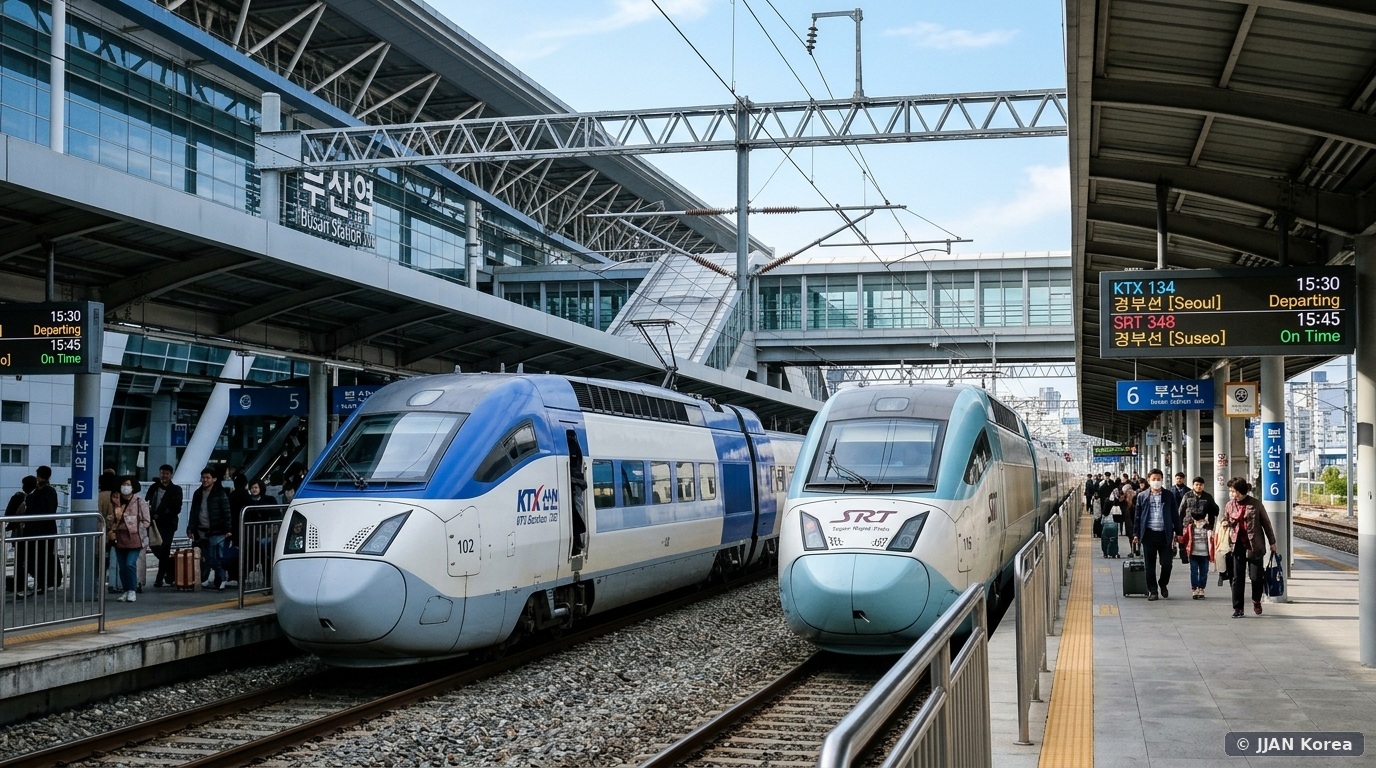

Connecting South Korea’s hyper-futuristic capital of Seoul with its vibrant southern maritime metropolis of Busan is the nation’s premier travel corridor. Spanning approximately 325 kilometers across the geographical spine of the peninsula, journeying from the historical palaces of Seoul to the sun-drenched beaches of Haeundae and the bustling seafood stalls of Jagalchi Market is an essential rite of passage for every foreign tourist and resident.
However, modern travelers face a genuine strategic dilemma: Should you take the high-speed KTX bullet train from Seoul Station, board the newer SRT train from Gangnam, catch a domestic shuttle flight from Gimpo Airport to Gimhae, or take a budget luxury express bus? While airlines advertise 55-minute flight times, door-to-door transit logistics, airport security screening, and suburban airport transfers radically shift the equation. This comprehensive, field-verified guide breaks down the true door-to-door speeds, ticket pricing matrices, luggage handling rules, and scenic trade-offs in 2026.
1. Comprehensive Transit Comparison Matrix: Seoul to Busan
Review the empirical metrics across all four intercity transportation modes before booking your journey:
| Transit Mode | One-Way Fare (Standard Adult) | Station-to-Station Time | True Door-to-Door Travel Time | Best Suited For |
|---|---|---|---|---|
| KTX Bullet Train (코레일) | ₩59,800 (Standard) | ₩83,700 (First Class) | 2 hrs 15 mins – 2 hrs 40 mins | Approx. 2 hrs 45 mins (Downtown to downtown) | #1 Overall Winner; travelers staying in central/western Seoul (Myeongdong, Hongdae, Jongno) |
| SRT Bullet Train (에스알티) | ₩52,600 (Standard) | ₩76,300 (First Class) | 2 hrs 10 mins – 2 hrs 30 mins | Approx. 2 hrs 40 mins (From Gangnam base) | Tourists & expats based in southern Seoul (Gangnam, Jamsil, Pangyo); approx. 12% cheaper than KTX |
| Domestic Flight (GMP ➔ PUS) | ₩45,000 – ₩110,000 (Highly seasonal) | 55 minutes (Flight time only) | Approx. 3 hrs 30 mins – 4 hrs (Security, baggage, transfers) | Budget airline deal hunters and travelers connecting from international flights at Gimpo |
| Premium Express Bus (고속버스) | ₩26,000 (Standard) – ₩48,000 (Luxury Sleeper) | 4 hrs 15 mins (Subject to highway congestion) | Approx. 4 hrs 45 mins | Overnight budget travelers taking late-night sleeper coaches to save hotel costs |
2. Why High-Speed Rail Beats Domestic Flights: The Door-to-Door Audit
At first glance, airline booking portals advertising flight times of just 55 minutes between Seoul Gimpo (GMP) and Busan Gimhae (PUS) appear vastly superior to a 2.5-hour train journey. However, an empirical audit of the complete door-to-door transit chain reveals the flight illusion:
The True Flight Timeline (Total: ~3.5 to 4 Hours)
The High-Speed Rail Timeline (Total: ~2.5 Hours)
Verdict: High-speed rail is faster, vastly more comfortable, provides uninterrupted mobile connectivity, and features zero luggage weight surcharges. Reserve your train tickets with our step-by-step guide to booking high-speed KTX train tickets in Korea.
3. KTX vs. SRT: Which Departure Station Matches Your Hotel?
Choosing between KTX and SRT depends almost entirely on your geographic base in Seoul:
- Choose KTX (Seoul Station or Yongsan Station): If your accommodation is situated in Myeongdong, Hongdae, Sinchon, Itaewon, Jongno, or Dongdaemun. Taking the subway to Seoul Station takes 5 to 15 minutes. KTX tickets can be booked on the English LetsKorail.com portal using foreign credit cards with zero booking fees.
- Choose SRT (Suseo Station): If your hotel is located in Gangnam, Jamsil (Lotte World), Yeoksam, or southern satellite hubs like Pangyo. Suseo Station is situated on Subway Line 3 and the Suin-Bundang Line. Traveling from Gangnam Station to Suseo takes just 18 minutes, sparing you a 45-minute subway trek across town to Seoul Station. SRT fares are also approximately 12% lower than KTX. While in Seoul, navigate metro lines using our Seoul Climate Card vs. T-Money transit comparison.
4. Premium Luxury Express Buses: The Late-Night Sleeper Alternative
If you are traveling on a tight budget or want to save the cost of a hotel night, Premium Gold Express Buses (프리미엄 고속버스) departing from Seoul Express Bus Terminal (Gyeongbu Line in Banpo) offer an extraordinarily luxurious overnight journey:
- First-Class Airplane Pods: Configured in a spacious 2+1 layout with only 21 seats per coach. Seats recline to 160 degrees, feature private privacy curtains around every pod, personal touchscreen multimedia monitors, wireless smartphone charging docks, and USB ports.
- Midnight Departures: Late-night sleeper coaches depart hourly between 11:00 PM and 2:00 AM, arriving at Busan Central Bus Terminal (Nopo) around 5:30 AM to 6:00 AM—just in time to catch sunrise over Haeundae Beach.
- Fares: Daytime Premium bus tickets cost approximately ₩44,000, while late-night premium coaches cost approx. ₩48,000 (still cheaper than a standard KTX ticket).
5. Arriving in Busan: Navigating Onward Transit to Haeundae & Gwangalli
When your high-speed train pulls into Busan Station (부산역), you are in the historic harbor district of the city. To reach the premier coastal beach zones:
6. Frequently Asked Questions (FAQ)
Can I use my Seoul Climate Card in Busan?
No. The Seoul Climate Card is strictly valid only on municipal transit within Seoul borders. It does not work on KTX trains, SRT trains, or the Busan Metro system. You must carry a standard rechargeable T-Money Card or purchase single-journey tokens for Busan public transit.
Can I take large surfboards or oversized luggage on the KTX to Busan?
Standard hard-shell suitcases, foldable strollers, and mid-sized sports equipment are fully permitted and fit into the dedicated luggage racks at the end of each carriage. However, oversized rigid surfboards exceeding 158cm in total dimensions are prohibited inside passenger carriages under Korail safety regulations; surfboards must be shipped via intercity courier services.
Which side of the KTX train has the best scenic views between Seoul and Busan?
Both sides offer beautiful panoramas of South Korea’s mountainous topography, river valleys, and agricultural basins. However, sitting on the left side (facing forward toward Busan) provides sweeping vistas of the Geumgang River basin and the ancient historical plains surrounding Gyeongju.
Are there luggage lockers available inside Busan Station?
Yes. Busan Station operates dozens of automated electronic luggage locker banks across the 1st and 2nd-floor concourses. Lockers cost between ₩3,000 and ₩8,000 per day depending on size and accept T-Money cards, Korean credit cards, and cash. Additionally, luggage delivery services (such as ZimCarry) will transport your bags directly from Busan Station to your Haeundae hotel while you explore the city hands-free.
🛡️ JJAN Korea Editorial Standards & Fact-Checking Verification
This article was independently researched, field-tested, and audited by the JJAN Korea Global Transit & Rail Desk in Seoul. Transit schedules, ticketing algorithms, and airport transfer transit times cross-verified with Korail, SR Corp, and domestic aviation timetables.
Notice an unlisted policy change, fare update, or revised administrative rule? Help us keep our international community accurately informed: Submit a Correction to our Seoul Newsroom.