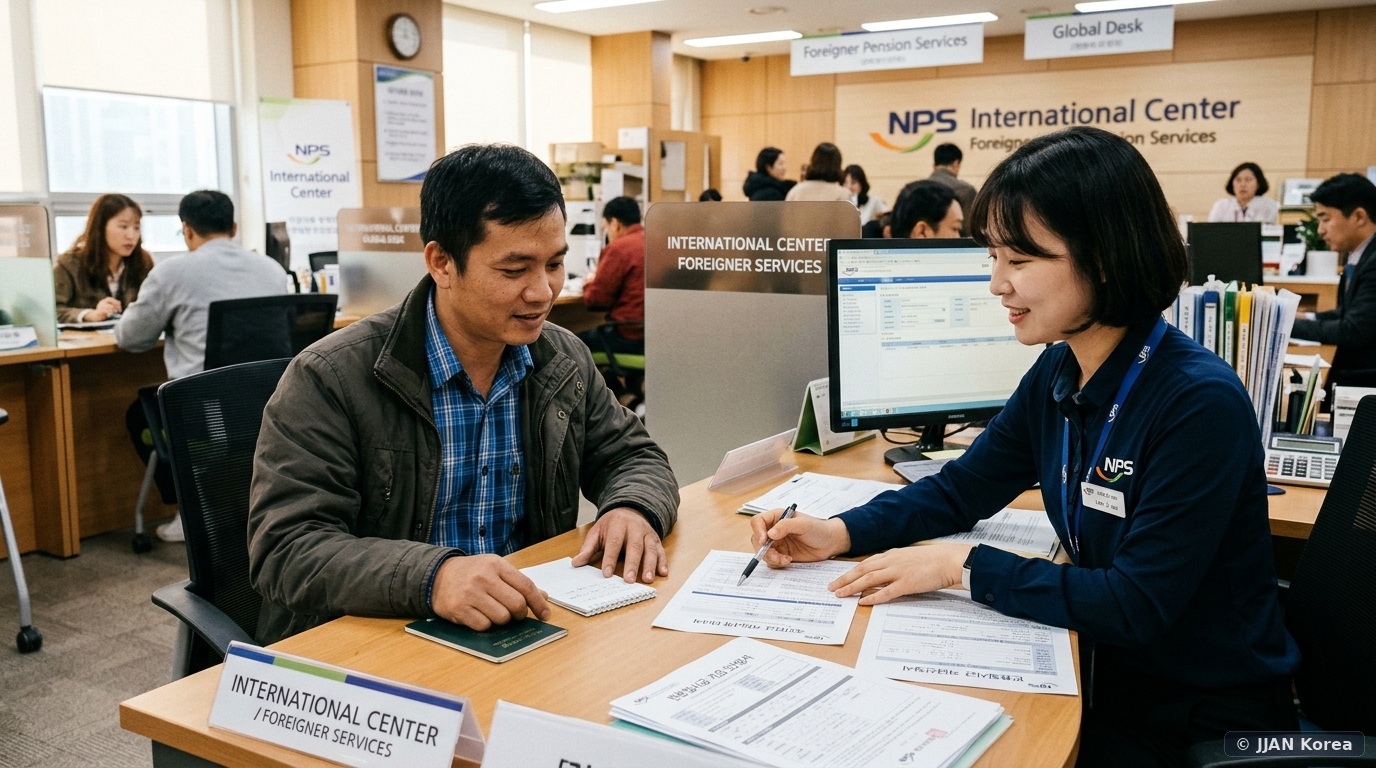
For foreign nationals employed in South Korea under work visas (such as E-7 professional, E-9 non-professional, or F-series residency), reviewing your monthly corporate pay stub often triggers surprise: a substantial deduction labeled National Pension (국민연금 / Gukmin Yeongeum) claims an mandatory 4.5% of your gross monthly salary, matched by an equal 4.5% contribution from your employer (totaling 9.0% monthly).
Over a standard two-to-five-year professional tenure in Seoul, this cumulative retirement reserve routinely swells to millions or tens of millions of Korean Won. The critical question facing every departing expatriate is: Can you reclaim 100% of this accumulated capital—plus accrued statutory interest—as a cash lump-sum refund when you conclude your stay in Korea? The answer is defined strictly by international bilateral diplomacy and nationality-specific reciprocity treaties. This comprehensive legal guide details nationality eligibility lists, calculation formulas, airport cash payout protocols, and the document checklist needed in 2026.
1. Legal Foundations: The Principle of Bilateral Reciprocity
Under Article 126 of the National Pension Act, foreign employees working in South Korea are subject to compulsory enrollment. However, eligibility to receive a Lump-Sum Refund Upon Departure (반환일시금) is strictly governed by the Principle of Reciprocity (상호주의): South Korea only pays lump-sum pension refunds to citizens of countries whose domestic pension laws grant equivalent cash refund benefits to Korean citizens residing in their territory.
| Eligibility Category | Qualifying Countries & Jurisdictions | Refund Mechanism |
|---|---|---|
| Category A: Bilateral Social Security Agreement (사회보장협정) | United States, Canada, Germany, Australia, Hungary, France, Czech Republic, Poland, Slovakia, Bulgaria, Romania, Austria, Belgium, India, Turkey, Switzerland, Brazil | Eligible for 100% Lump-Sum Refund upon departure OR can totalize contribution years toward their home country pension eligibility. |
| Category B: Reciprocity Under National Law (국적별 상호주의) | Philippines, Malaysia, Indonesia, Thailand, Sri Lanka, Kazakhstan, Uzbekistan, Mongolia, Jordan, Tunisia, Bermuda, Grenada, Colombia, Belize, Vanuatu, Ghana | Eligible for 100% Cash Lump-Sum Refund upon permanent departure from Korea under statutory reciprocity. |
| Category C: Non-Eligible Countries (환급 불가 국가) | United Kingdom, South Africa, Ireland, New Zealand, China, Vietnam, Myanmar, Cambodia, Singapore, Japan, Italy, Spain, Netherlands, Sweden, Norway | NOT eligible for cash lump-sum refund upon departure. Contributions remain locked in Korea until age 60+ (or totalized under specific bilateral coordination rules). |
2. Calculating Your Payout: Principal Plus Statutory Interest
If your nationality qualifies under Category A or B, your lump-sum refund calculation is extraordinarily generous:
Total Payout = [Employee 4.5% Contributions] + [Employer 4.5% Matching Contributions] + [Accrued Statutory Compound Interest]
You do not merely receive the 4.5% deducted from your monthly paycheck; you receive the entire matching 4.5% deposited by your corporate employer, along with statutory annual compound interest calculated according to national banking deposit rates. For a foreign professional earning an average monthly gross salary of ₩4,000,000 across a 3-year employment contract, the lump-sum cash refund payout typically totals approximately ₩13,500,000 to ₩14,500,000+ ($10,000 – $11,000 USD). Learn about managing foreign exchange remittances in our Korean bank account opening guide.
3. The Departure Timeline: When & How to Apply
You cannot apply for a pension refund months in advance while actively employed. The National Pension Service (NPS / 국민연금공단) enforces a strict application window:
- The Earliest Filing Date: You can submit your application at an NPS branch office within one month prior to your confirmed international departure date.
- The 5-Year Statute of Limitations: Under Article 115 of the National Pension Act, your right to claim a lump-sum refund expires if not claimed within 5 years from the date you permanently depart South Korea. If unclaimed after 5 years, the capital legally reverts to the national treasury.
- Employment Termination Prerequisite: Your employer must officially file your corporate health and pension disenrollment paperwork (상실신고) with the government before your refund can be processed. Coordinate your legal residency departure with our Alien Registration Card (ARC) guide.
4. Mandatory Document Dossier Checklist
Visit any physical National Pension Service (NPS) local branch office nationwide with the following complete documentation:
- Method A (Domestic Korean Bank Account): A copy of your active Korean bank book (통장). Payout is wired within 3 to 7 business days following your confirmed departure flight.
- Method B (Overseas Wire to Foreign Bank Account): An official English bank statement displaying your foreign bank’s Name, Account Number, SWIFT/BIC Code, and Routing/IBAN details.
5. Incheon Airport Same-Day Cash Payout Protocol
If you qualify by nationality and do not want to wait for international bank wires, the NPS operates an exceptional Airport Same-Day Cash Payout Service (공항지급 서비스) at Incheon International Airport:
6. Frequently Asked Questions (FAQ)
What if I am from an ineligible country like the UK, China, or South Africa?
If your nationality is ineligible for a cash refund, your contributions are not stolen or erased. They remain held in your encrypted NPS account. Under bilateral totalization treaties, your years of Korean pension contributions can be added to your home country’s social security system to help you qualify for full state retirement pensions at age 60 or 65. If you ever return to work in Korea in the future, your previous contribution history reactivates immediately.
Is the lump-sum pension refund subject to Korean income taxes?
Because monthly pension contributions were deducted pre-tax from your salary, a small statutory retirement income tax (typically 3% to 6%) is withheld when the refund is disbursed, depending on your total duration of stay and earnings level. The remaining 94%+ is paid directly into your hands.
What is the difference between the National Pension refund and Severance Pay (퇴직금)?
They are completely separate legal entitlements! National Pension is a government social security fund administered by the state NPS. Severance Pay (Toejikgeum / 퇴직금) is a corporate benefit legally mandated under the Labor Standards Act requiring your private employer to pay you one full month of average salary for every continuous year of employment. Departing foreign workers from eligible countries are entitled to receive BOTH their full severance pay from their company AND their full pension refund from the government!
Can I apply for the pension refund online after I have already returned home?
Yes, provided you file within the 5-year statutory window. You must download the overseas application form from the NPS website, have your signature notarized by a Korean Embassy or Consulate in your home country, attach your original passport copy and bank details, and mail the physical dossier to the National Pension Service International Center in Seoul via registered postal mail.
🛡️ JJAN Korea Editorial Standards & Fact-Checking Verification
This article was independently researched, field-tested, and audited by the JJAN Korea Social Welfare & Expat Pension Desk in Seoul. Audited with the National Pension Service (NPS) International Center in Seoul; bilateral social security totalization agreements verified with 2026 NPS schedules.
Notice an unlisted policy change, fare update, or revised administrative rule? Help us keep our international community accurately informed: Submit a Correction to our Seoul Newsroom.