
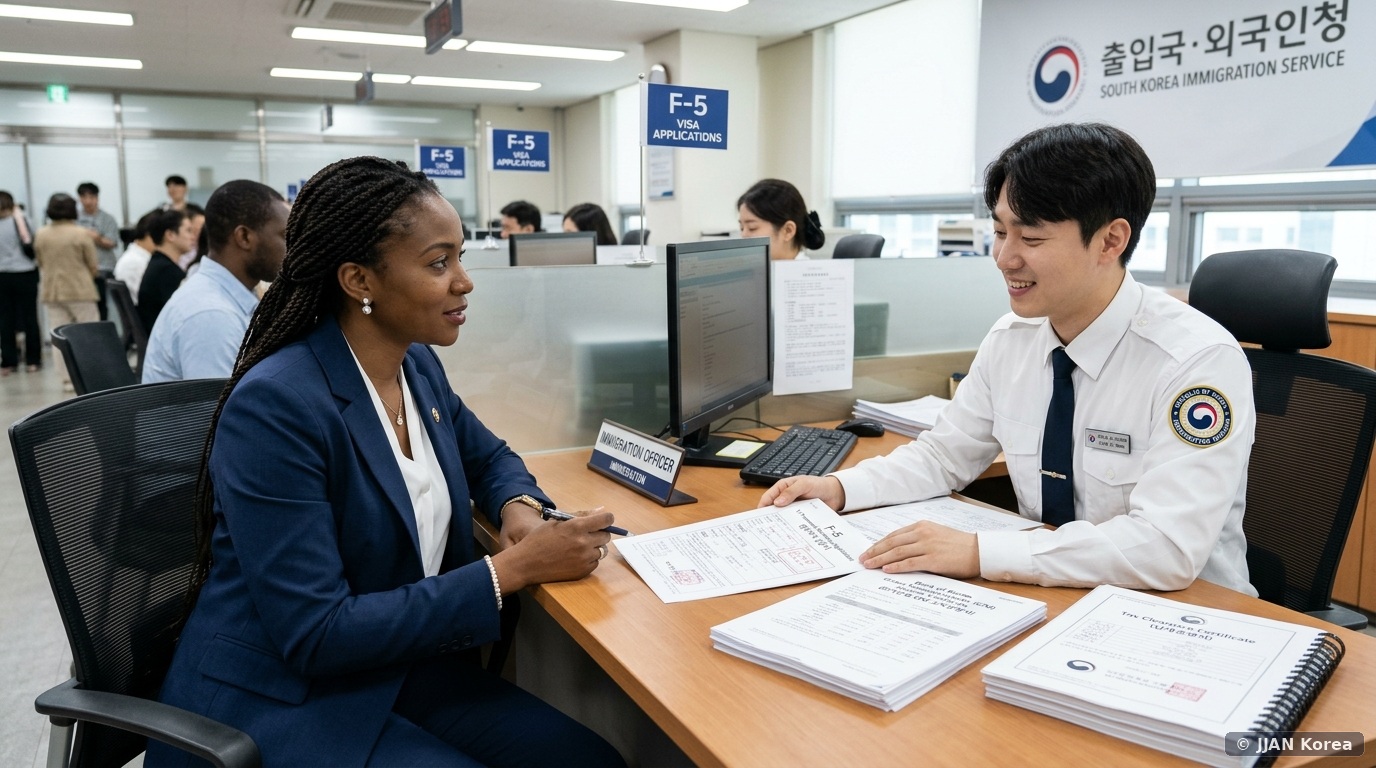
Among all foreign residency categories administered by the South Korean Ministry of Justice (MOJ – 법무부), the F-5 Permanent Residency Status (Yeong-ju-gwon – 영주권) represents the supreme legal holy grail. Earning permanent residency severs all dependence on employer sponsorship, liberates visa holders from the perpetual anxiety of annual visa renewals, grants total freedom to work, start commercial businesses, or take sabbaticals without immigration interference, provides local municipal voting rights in local district elections, and ensures that you can never be deported except for the most severe national security felonies. However, as South Korea tightened immigration quality filters, qualifying for an F-5 visa has evolved into a demanding marathon requiring rigorous financial income benchmarks measured against Gross National Income (GNI), mandatory mastery of the Korean language, and flawless legal compliance.
1. Major F-5 Sub-Categories: Income Multipliers and Degree Paths
The F-5 visa is not a single monolith; it encompasses over 20 distinct legal sub-categories, each tailored to specific resident profiles:
| F-5 Sub-Category | Underlying Precursor Visa | Residency Duration | Financial Income Threshold (GNI Benchmark) |
|---|---|---|---|
| F-5-1 (General Permanent Residency) | D-8, E-7, or other long-term visas | 5+ Years Continuous Stay | 2x Gross National Income (GNI) (approx. 88M+ KRW) |
| F-5-2 (Spouse of Korean Citizen) | F-6 Marriage Migrant Visa | 2+ Years Continuous Stay | 1x GNI (Shared household income accepted) |
| F-5-10 (Korean Bachelor’s / Master’s Degree) | D-2 Graduate ➔ E-7 Professional | 3+ Years Continuous Stay | 1x GNI (approx. 44M+ KRW in previous calendar year) |
| F-5-16 (F-2-7 Points Visa Transition) | F-2-7 Long-Term Residency | 3+ Years Continuous Stay | 1x GNI (Bachelor’s degree) OR 2x GNI |
| F-5-15 (PhD Degree in High-Tech Sciences) | PhD graduate employed at Korean firm | 1+ Year Continuous Stay | 1x GNI threshold |
For skilled expatriates holding points-based residency, by transitioning from an F-2-7 points visa to unconditional F-5 permanent residency, the required residency waiting period is dramatically reduced from 5 years down to 3 years.
2. The Financial Benchmark: Navigating the Bank of Korea’s GNI
The financial income baseline for F-5 permanent residency is pegged directly to the Gross National Income (GNI / Guk-min Chong-so-deuk) per capita published annually by the Bank of Korea (BOK). For applications submitted in 2026, the relevant GNI benchmark hovers at approximately 44,000,000 to 45,000,000 KRW.
Crucial Adjudication Rule: Immigration adjudicators calculate income exclusively from the official Certificate of Income Amount (So-deuk Geum-aek Jeung-myeong-won) issued by the National Tax Service (Hometax) for the preceding tax year. Company salary certificates, future pay projections, and cash bonuses that were not subjected to statutory earned income tax withholding are 100% disqualified. In addition, the applicant must have maintained steady, legal employment in South Korea at the time of final application submission.
3. The Civic Knowledge Requirement: KIIP Stage 5 Mastery
Beyond financial wealth, applicants must prove deep integration into Korean society under Article 12-3 of the Immigration Control Act Enforcement Rules. You must fulfill one of the following official criteria:
- Pass the Comprehensive Evaluation for Permanent Residency (K-CIP): Score 60 points or higher out of 100 on the official Korea Immigration and Integration Program comprehensive exam.
- Complete KIIP Stage 5: By passing the final Comprehensive Evaluation for Permanent Residency (K-CIP) and completing the 70-hour “Understanding Korean Society” course, you satisfy the permanent residency civic requirement permanently.
- Alternative TOPIK Exemption: Certain high-tech PhD tracks (F-5-15) and major international investors can substitute a Test of Proficiency in Korean (TOPIK) Level 4 certificate or higher.
4. Criminal Record Clearance: The Apostilled Home Country Certificate
Immigration authorities require all applicants to prove “Good Conduct” (Pumhaeng Danjeong). You must submit a nationwide federal criminal history record check issued by your home country’s central government (e.g., FBI Identity History Summary for US citizens, RCMP Certified Criminal Record for Canadians, ACRO Police Certificate for UK citizens).
The criminal record check must be formally legalized with an Apostille (or consular authentication for non-Hague nations) and translated into Korean. The document is valid for only six months from its date of issuance. Any felony convictions, DUI offenses with fines exceeding 3,000,000 KRW, or repeated immigration violations inside South Korea will result in an automatic rejection and a mandatory 3-to-5-year application ban.
5. Bank of Korea Gross National Income Audit & Mandatory Tax Clearance Protocols
When applying for the prestigious F-5 permanent resident status (Yeongjoo-gwon), the financial evaluation benchmark is calculated with absolute mathematical precision based on the Bank of Korea’s (BOK) official Gross National Income (GNI) per capita for the preceding calendar year. The BOK officially publishes its audited annual GNI figures every year in late March. Applications submitted prior to the March announcement are evaluated against the prior year’s benchmark, whereas applications filed after March must satisfy the newly updated figure.
For standard F-5-1 general permanent residency applicants, the baseline threshold requires an earned gross annual income exceeding 2.0 times the per capita GNI. With recent annual GNI figures hovering around 44 million to 47 million KRW, applicants must demonstrate verifiable individual annual earnings between 88 million and 94 million KRW. For applicants qualifying under specialized degree or high-tech points pathways (such as F-5-10 science/engineering masters graduates), the threshold is substantially reduced to 1.0 times GNI, significantly expediting permanent residence attainment.
Crucially, immigration adjudication officers categorically reject informal pay stubs, corporate offer letters, or personal bank deposit printouts as evidence of income. The sole legally admissible proof is the official Certificate of Earned Income (So-deuk Geum-aek Jeung-myeong-won – 소득금액증명원), which must be issued directly by the National Tax Service (NTS – Hometax) bearing the official NTS digital seal and verification barcode.
In addition to income proof, applicants must submit an official Certificate of National and Local Tax Payment (Guk-se / Ji-bang-se Wan-nap Jeung-myeong-seo). Under Article 10 of the Framework Act on National Taxes, even a single unpaid parking fine, minor municipal residence tax surcharge (Juminse), or delinquent health insurance premium of 10,000 KRW will trigger an automatic administrative freeze on your permanent residency dossier until the liability is completely resolved and verified on the government database.
Once granted, F-5 permanent residency provides immense lifelong civil privileges: your stay status is perpetual and no longer tied to an employer sponsorship; you are completely exempt from re-entry permit requirements when traveling abroad for up to two years; your spouse and minor children qualify for immediate long-term F-2-3 residency; and under Article 15 of the Public Official Election Act, foreign permanent residents who have held F-5 status for at least three consecutive years acquire the legal right to vote in local municipal and mayoral elections.
When lodging your formal F-5 dossier, prepare 200,000 KRW for the statutory government revenue stamp (Su-ip In-ji) and 30,000 KRW for physical permanent resident card issuance. Adjudication takes between 6 and 10 months; once approved, you receive the distinctive dark blue permanent resident card, representing the pinnacle of foreign legal residency in South Korea. Furthermore, downloading your official tax clearance certificates directly from the Hometax or Government24 mobile portals takes less than five minutes using your Joint/Financial Certificate or Kakao simple authentication, streamlining your application prep significantly. Always verify that your passport validity extends at least six months beyond your filing date to ensure continuous legal processing.
5. Frequently Asked Questions (FAQ)
Q1: Does an F-5 Permanent Residency card ever expire?
Under current immigration law, your underlying permanent residency status never expires. However, the physical plastic F-5 card features a 10-year renewal cycle (similar to a domestic passport). Every 10 years, you must visit your local immigration office for a routine photo update and card reprint.
Q2: Can I lose my F-5 Permanent Residency if I travel abroad for too long?
YES! This is the most critical rule for F-5 holders: under Article 30 of the Immigration Control Act, F-5 holders enjoy an automatic two-year re-entry permit exemption. However, if you remain outside South Korea for longer than two continuous calendar years without obtaining an official extension from an overseas Korean embassy, your F-5 permanent residency is permanently and irreversibly revoked!
Q3: Can my spouse and children obtain visas if I get an F-5?
Yes! The legal spouse and minor children of an F-5 permanent resident are eligible to receive the F-2-3 (Permanent Resident Dependent) Visa, which grants unrestricted work rights in South Korea and allows children to attend local schools with complete equality.
Q4: Do F-5 permanent residents really have voting rights in South Korea?
Yes! Under Article 15 of the Public Official Election Act, foreign residents who have held F-5 permanent residency for more than three years and are registered on the local municipal resident registry are legally eligible to vote in Local Elections (Ji-bang Seon-geo)—voting for municipal mayors, provincial governors, and city council members.
🛡️ JJAN Korea Editorial Standards & Fact-Checking Verification
This F-5 permanent residency legal guide has been authored and verified by Finance Editor Seo-jun Kim following statutory adjudication manuals issued by the Korea Immigration Service (Ministry of Justice).
- GNI per capita benchmarks cross-checked with official Bank of Korea National Accounts economic releases.
- Social integration language criteria audited under Article 12-3 of the Immigration Control Act Enforcement Rules.
- Criminal background check validity and Apostille protocols confirmed with HiKorea Civil Petition Service Regulations.