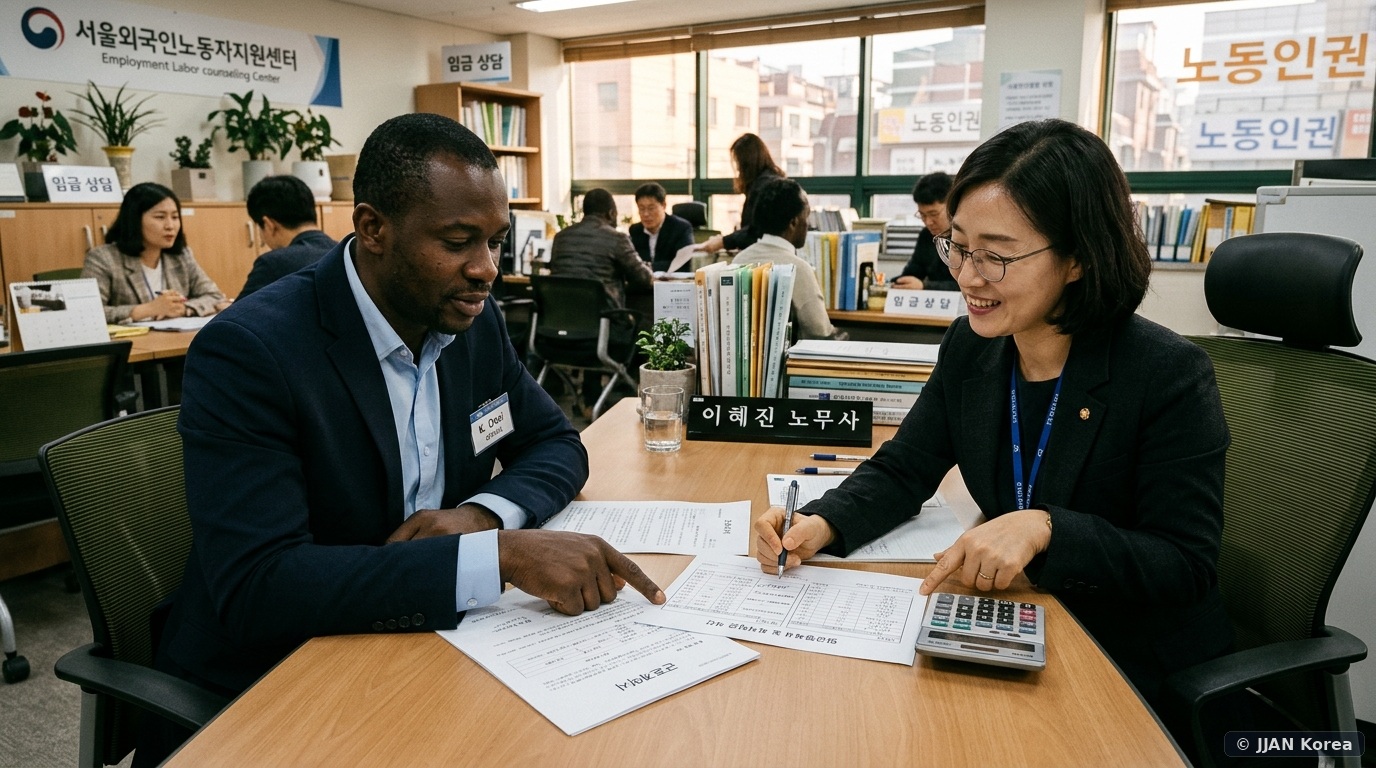
The Republic of Korea has officially ushered in a historic milestone in labor rights: effective January 1, 2026, the national minimum wage has surpassed the 10,000 won benchmark, rising to 10,030 KRW per hour. Promulgated by the Ministry of Employment and Labor (MOEL) under the Minimum Wage Act and the Labor Standards Act, this statutory baseline applies unconditionally to every employer across South Korea—and critically, it protects every foreign national legally employed within the country.
Whether you hold an E-9 (Non-professional Employment) permit in manufacturing or agriculture, an H-2 (Working Holiday / Visit Employment) visa, an E-7 (Specialized Foreign Worker) classification, an E-8 (Seasonal Worker) visa, or a D-2 international student visa with authorized part-time work clearance, South Korean labor law strictly prohibits nationality-based wage discrimination. Below is the definitive, field-verified legal guide to calculating your statutory monthly salary, understanding overtime multipliers, defending against unlawful dormitory and meal deductions, and securing rapid administrative remedy through the Ministry of Employment and Labor.
1. 2026 Statutory Minimum Wage Framework & Standard Monthly Pay
Under Article 6 of the Labor Standards Act (근로기준법) and the Korean Minimum Wage Act (최저임금법), statutory minimum wage protections cover all workplaces nationwide, from heavy industrial complexes in Gyeonggi-do to small convenience stores and agricultural farms. No private contract, employment memorandum, or verbal agreement can legally pay less than the statutory rate. Any contractual clause attempting to waive this right is void under South Korean law.
For standard full-time employees working 40 hours per week (8 hours per day, 5 days per week), South Korean labor calculations incorporate statutory Weekly Paid Holiday Hours (주휴수당). Under Article 55 of the Labor Standards Act, an employee who completes their scheduled weekly working days is entitled to 8 hours of paid rest. Consequently, the official monthly contractual calculation standard is established at 209 hours per month: (40 regular hours + 8 weekly holiday hours) × (365 days ÷ 7 days ÷ 12 months) = 208.57, rounded up to 209 hours.
| Metric & Pay Category | 2024 Benchmark | 2025 Standard | 2026 Statutory Standard |
|---|---|---|---|
| Hourly Minimum Wage | 9,860 KRW | 10,030 KRW | 10,030 KRW / hour |
| Daily Pay (8-Hour Standard Day) | 78,880 KRW | 80,240 KRW | 80,240 KRW / day |
| Standard Monthly Base (209 Hours) | 2,060,740 KRW | 2,096,270 KRW | 2,096,270 KRW / month |
| Weekly Paid Holiday Allowance (주휴수당) | 78,880 KRW / week | 80,240 KRW / week | 80,240 KRW / week |
| Overtime Hourly Rate (1.5x Premium) | 14,790 KRW / hr | 15,045 KRW / hr | 15,045 KRW / hr |
| Night Work Rate (22:00–06:00, 2.0x) | 19,720 KRW / hr | 20,060 KRW / hr | 20,060 KRW / hr |
Every foreign worker must ensure their net monthly deposits align with their official pay slip (급여명세서). In South Korea, employers are legally required under Article 48 of the Labor Standards Act to provide an itemized written or electronic pay slip specifying basic pay, overtime calculations, statutory insurance deductions, and tax withholdings. If you receive your wages into a verified bank account—as detailed in our Korean Bank Account Opening Guide for Foreigners—keep every monthly deposit statement saved digitally.
2. Statutory Overtime, Night Work, and Holiday Multipliers
Under South Korea’s 52-hour weekly work cap (40 regular hours plus a statutory maximum of 12 hours of overtime), extra work requires legally mandated premium multipliers under Article 56 of the Labor Standards Act for all businesses with five or more permanent employees (5인 이상 사업장):
A. Extended Overtime (연장근로수당)
Any work performed beyond 8 hours in a single day or beyond 40 hours in a single week must be compensated at 150% (1.5x) of the regular hourly wage. In 2026, the statutory overtime wage rate cannot fall below 15,045 KRW per hour.
B. Night Shift Premium (야간근로수당)
Work performed during nighttime hours—defined strictly between 22:00 (10:00 PM) and 06:00 (6:00 AM)—entitles the employee to an additional 50% premium. If nighttime work coincides with extended overtime (as is frequent in overnight manufacturing or logistics shifts), both multipliers compound: 100% Base + 50% Overtime + 50% Night Work = 200% (2.0x), yielding a minimum of 20,060 KRW per hour.
C. Holiday Work Allowance (휴일근로수당)
Working on statutory holidays (including Red Days / public holidays and Labor Day on May 1) entitles employees to:
- First 8 Hours on a Holiday: 150% (1.5x) of regular hourly wage (15,045 KRW/hr).
- Hours Exceeding 8 Hours on a Holiday: 200% (2.0x) of regular hourly wage (20,060 KRW/hr).
3. Defending Against Unlawful Room and Board Deductions
One of the most frequent labor exploitation tactics encountered by E-9 and E-8 foreign workers involves excessive, unilateral deductions for company-provided housing (기숙사비) and daily meals (식대). The Ministry of Employment and Labor has instituted rigorous compliance benchmarks to protect foreign workers from predatory deductions:
The Statutory Accommodation Deduction Ceiling
Under MOEL administrative directives, employers who provide housing may only deduct a predefined percentage of the worker’s monthly wages, provided the facility meets strict human dignity and building safety codes:
- Apartments, Detached Houses & Multi-family Residential Units: Deduction capped at a maximum of 15% to 20% of standard monthly base wage (depending on whether meals are included).
- Temporary Structures & Modular Facilities (Permitted Prefabricated Units): Deduction strictly capped at 8% to 13%. Facilities must have heating, cooling, fire detectors, and proper sanitary plumbing.
- Substandard Vinyl Greenhouses & Container Barracks (비닐하우스 내 컨테이너): Completely prohibited under South Korean law. If an employer houses workers in unauthorized temporary structures inside greenhouses, the local labor board will immediately authorize an emergency Workplace Transfer (사업장 변경) without employer consent, and zero housing deductions are permitted.
The Written Consent Requirement
Deductions cannot be made automatically or verbally. Article 43 of the Labor Standards Act codifies the Principle of Full Payment of Wages (전액지급의 원칙). An employer may only deduct housing or food costs if the worker has signed an official, bilingual written deduction agreement (공제동의서) explicitly detailing the exact breakdown. If an employer deducts 500,000 KRW for a shared room worth 150,000 KRW without a valid agreement, this constitutes criminal wage theft.
4. Step-by-Step Procedure: Reporting Wage Violations & Unpaid Pay to MOEL
If your employer fails to pay the 2026 minimum wage of 10,030 KRW per hour, withholds overtime premiums, or deducts unauthorized living expenses, take the following administrative steps immediately to secure formal legal remedy:
Step 1: Compile Objective Employment Evidence
Gather your standard employment contract (표준근로계약서), monthly bank transfer records, daily attendance records (time-card photos, KakaoTalk work logs, or factory entrance records), and copies of your official Alien Registration Card (ARC). Do not rely solely on verbal discussions.
Step 2: File a Labor Petition (진정서 접수)
Foreign workers have two accessible methods to file a formal wage violation claim with the Ministry of Employment and Labor:
- Online Petition: Visit the official MOEL Civil Service Portal (
labor.moel.go.kr) and submit an e-petition for unpaid wages (임금체불 진정). The portal is accessible with your registered foreigner digital verification. - In-Person Submission: Visit the regional labor office (지방고용노동청 / 고용노동지청) governing your workplace’s physical address. Every labor office provides interpretation assistance and assigned Labor Inspectors (근로감독관).
Step 3: Labor Inspector Investigation & Settlement
A Labor Inspector will summon both you and your employer for a joint factual examination (삼자대면 조사). If interpretation is needed, MOEL coordinates with the Foreign Worker Support Center (외국인근로자지원센터). The inspector calculates the exact unpaid statutory wage difference and issues an administrative Order to Pay (지급지시). If the employer refuses to comply within the deadline, criminal charges are forwarded to the District Prosecutors’ Office, and the foreign worker is issued an official Confirmation of Unpaid Wages (체불임금등·사업주확인서) to claim government substitute payouts (대지급금).
5. Crucial Documentation Checklist for Immigrant Workers
Ensure you maintain digital copies of the following documents in secure cloud storage throughout your employment in Korea:
- Standard Labor Contract (표준근로계약서): Specifying official working hours, rest breaks, hourly rate, and workplace location.
- Alien Registration Card (ARC) / Foreign Resident Card: Ensuring your personal immigration details match company records as outlined in our Korean Name Order & Spacing Verification Guide.
- Bank Passbook Transaction History (통장 거래내역): Documenting exact monthly net pay transfers from the employer’s registered business account.
- Itemized Wage Slips (급여명세서): Required by law; preserves your legal right to dispute miscalculated hours.
- Attendance & Overtime Records: Personal notes, punch card photos, or GPS work logs proving actual hours worked past 40 hours weekly.
- Four Major Social Insurances Confirmation: Ensuring enrollment in National Health Insurance as explained in our Korea NHIS Expat Health Insurance Guide and Industrial Accident Compensation Insurance (산재보험).
6. Frequently Asked Questions (FAQ)
Q1. Can an employer pay less than 10,030 KRW per hour during a probationary period (수습기간)?
Under Article 5 of the Minimum Wage Act, an employer may only deduct 10% from the minimum wage (paying 90% of the statutory rate, or 9,027 KRW/hr in 2026) for up to 3 months IF the employment contract is signed for a duration of 1 year or longer, AND the work is not classified as simple manual labor (단순노무직). For simple manual labor (such as construction assistants, agricultural harvesters, fast food cooks, and warehouse loaders), no probationary wage reduction is permitted by law; 100% of the minimum wage must be paid from day one.
Q2. Does the 2026 minimum wage apply to agricultural, livestock, and fishing workers (E-9, E-8)?
Yes. The statutory minimum hourly rate of 10,030 KRW applies equally to agricultural, livestock, and fishery workers. While Article 63 of the Labor Standards Act provides exceptions regarding overtime and rest-day premiums for agricultural businesses due to seasonal climate dependencies, the fundamental minimum wage per actual working hour is strictly mandatory. Weekly holiday allowance rules and baseline wage floors cannot be compromised.
Q3. What should I do if my employer threatens to cancel my visa if I report a wage violation?
Such threats are strictly illegal under the Act on the Employment of Foreign Workers (외국인근로자의 고용 등에 관한 법률). Under Article 25, when an employer violates labor law, delays wage payments, or abuses a worker, the foreign employee has the legal right to apply for a Workplace Change (사업장 변경) at the regional Employment Center (고용센터). In cases of proven wage theft or minimum wage violations, the transfer does NOT count against your statutory workplace transfer quota, and your visa status is legally protected while the complaint is processed.
Q4. Which emergency hotline provides free multilingual legal assistance for foreign workers?
You can immediately contact the Ministry of Employment and Labor Multilingual Counseling Center at 1350 (press extension for English, Vietnamese, Filipino, Chinese, Thai, Indonesian, etc.). Furthermore, you can contact the Korea Support Center for Foreign Workers at 1644-0644 for pro bono labor attorney consultations and in-person mediation support.
JJAN Korea Policy & Legal Verification Desk
Regulatory Reference: Minimum Wage Act (최저임금법) Articles 5 & 6, Labor Standards Act (근로기준법) Articles 6, 43, 48 & 56, and Ministry of Employment and Labor (MOEL) Directive No. 2025-104.
Verification Authority: Republic of Korea Ministry of Employment and Labor (고용노동부) & Korea Workers’ Compensation and Welfare Service (근로복지공단). This guide reflects authoritative statutory baseline figures enforced nationwide starting January 1, 2026.