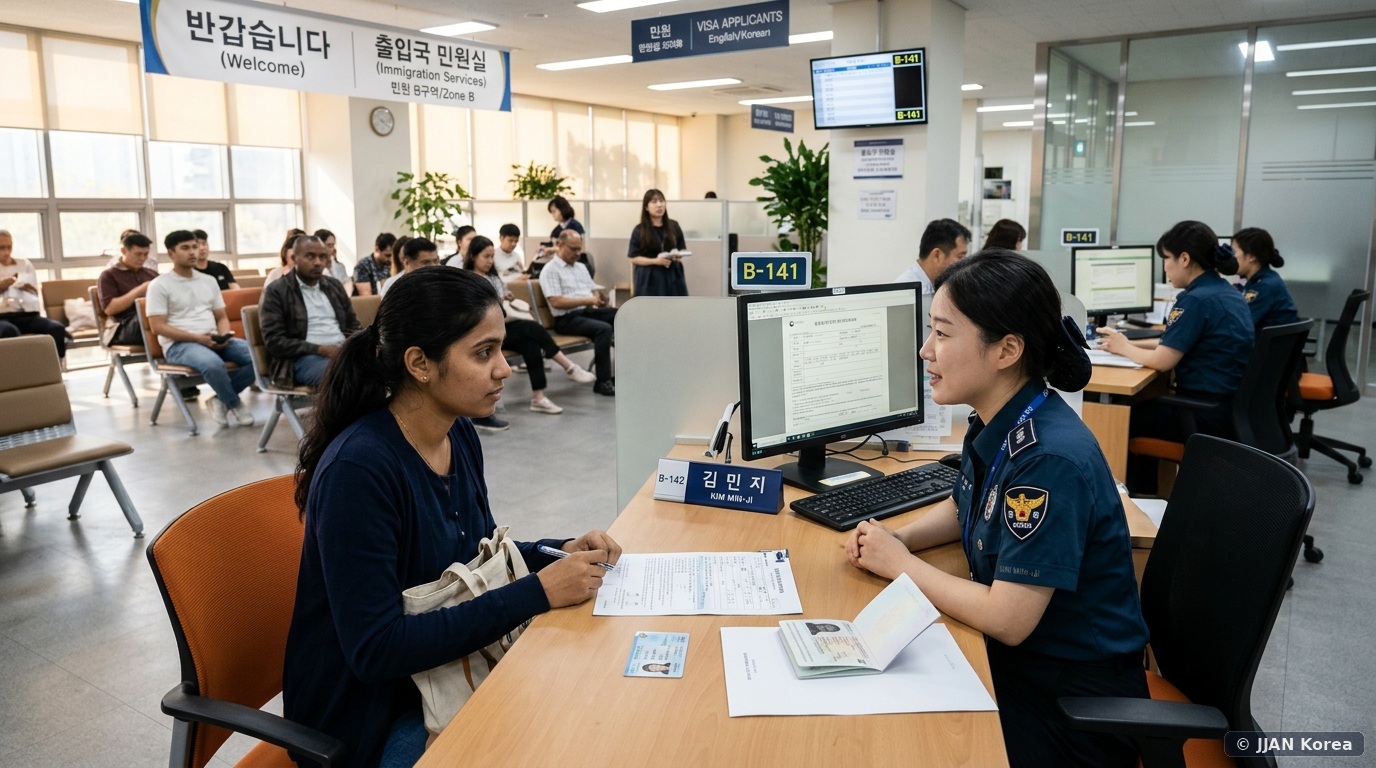

For any foreign national intending to reside in the Republic of Korea for more than 90 days, the Alien Registration Card (ARC / 외국인등록증)—recently officially re-titled as the Residence Card (외국인신분증)—is not merely an identification credential; it is the absolute operational keystone of your legal existence. Without an ARC, you cannot establish a postpaid smartphone plan, open a fully functional tier-1 domestic bank account, subscribe to National Health Insurance, or legally secure an apartment lease.
Under Article 31 of the Korean Immigration Act (출입국관리법), foreigners residing long-term must complete their foreigner registration within 90 days of arrival. Failing to meet this statutory timeline results in severe monetary fines exceeding ₩1,000,000 and jeopardizes future visa renewal eligibility. This exhaustive, field-verified guide walks you through every phase: conquering the HiKorea appointment backlog, assembling visa-specific document dossiers, navigating your physical immigration interview, biometric enrollment, and issuing your 2026 Mobile Digital Residence Card.
1. Legal Foundations & The Inflexible 90-Day Statutory Rule
Every foreign national holding a long-term visa (such as D-2 study, D-4 language training, D-10 job seeker, E-7 professional, or F-series residency) must submit an application for alien registration before the 90th calendar day from their port of entry date stamped in their passport. If you exit South Korea before completing registration, your single-entry long-term visa is automatically canceled upon departure, forcing you to reapply from abroad.
| Violation Timeline | Administrative Penalty (Immigration Act Art. 98) | Impact on Legal Status |
|---|---|---|
| 1 – 10 Days Overdue | ₩100,000 – ₩200,000 statutory fine | Written explanation required; visa renewal scrutinized |
| 11 – 30 Days Overdue | ₩200,000 – ₩500,000 fine | Mandatory investigation; potential refusal of extension |
| Over 90 Days Overdue | ₩1,000,000+ to criminal penalty | Classification as illegal stay (불법체류); formal deportation order |
2. HiKorea Online Appointment Booking: Tactical Strategies
The Ministry of Justice (법무부) strictly enforces a 100% mandatory advance reservation policy for in-person visits to all immigration offices nationwide. You cannot walk in off the street without an appointment number; security guards at immigration entrances will turn you away.
Due to massive seasonal inflows of international students in February/March and August/September, appointment slots at major offices (Seoul Immigration in Omokgyo, Sejongno Branch, and Southern Seoul Office) routinely book solid 4 to 8 weeks in advance. Utilize these tactical tips to secure a slot:
- Book Before You Fly: You can book a reservation on HiKorea.go.kr using your passport number and visa grant notice before even boarding your flight to Seoul.
- The 9:00 AM Cancellation Refresh Trick: Cancellations are batch-processed and released back into the HiKorea booking calendar daily between 8:55 AM and 9:05 AM KST. Refresh the calendar during this window to grab last-minute cancellations within the same week.
- Strict Jurisdictional Boundaries: You must visit the exact immigration office governing your residential address. If you live in Mapo-gu, you must book Seoul Immigration Office (Omokgyo). If you live in Jongno-gu, you must book the Sejongno Branch. Booking the incorrect branch results in instant refusal at the counter. Once your card is approved, coordinate your banking by reading our walkthrough on how to open a Korean bank account as a foreigner.
3. Comprehensive Document Dossier Checklist by Visa Classification
Arriving at your counter appointment missing even a single required government certificate means your application will be rejected, forcing you to re-book another appointment weeks out. Ensure your physical dossier contains the following:
Universal Core Documents (Required for ALL Visa Types)
- Application Form (통합신청서): Form No. 34, completed in clear English or Korean block letters with passport photograph affixed.
- Original Physical Passport: Must possess at least 6 months of remaining validity, along with a clean black-and-white photocopy of the biographical information page.
- Standard Passport Photo (1 Copy): 3.5cm × 4.5cm, taken within the last 6 months against a pure white background. Colored shirts recommended (no white clothing blending into the backdrop).
- Proof of Residence in Korea (체류지 입증서류): A signed housing lease agreement (Jeonse or Wolse rental contract) under your legal name, a university dormitory certificate, or a Confirmation of Accommodation (거주/숙소제공 확인서) accompanied by the host’s ID copy.
- Government Application Fees: ₩30,000 (Cash only for the revenue stamp / 수입인지 purchased at the on-site ATM or desk) + ₩4,000 optional postal delivery fee if opting to receive the card by certified mail.
Visa-Specific Supplementary Documents
- D-2 Degree Students: Certificate of University Enrollment (재학증명서) issued within 14 days, Business Registration Certificate of the university (사업자등록증).
- D-4 Language Trainees: Certificate of Course Registration, tuition receipt, attendance verification notice.
- D-10 Job Seekers: Detailed 6-Month Job Seeking Plan (구직활동계획서), certified degree certificate, transcript.
- E-7 Professional Employees: Employment Contract (original and copy), Dispatch Order, Corporate Certificate of Registry (등기부등본), Corporate Tax Payment Certificate, and Business Registration Certificate.
- Designated National Tuberculosis (TB) Clearance Certificate: Foreigners arriving from 35 high-burden TB countries (including China, Vietnam, India, Philippines, Indonesia) must submit an official chest X-ray screening certificate issued by a neighborhood public health center (보건소) or designated hospital.
4. Day of the Appointment: What Happens at the Counter
Arrive at the immigration office at least 20 minutes prior to your reserved time. The processing sequence follows a structured operational flow:
5. 2026 Innovation: Mobile Digital Residence Card
Starting in 2025 and fully institutionalized in 2026, the Ministry of Justice introduced the Mobile Digital Residence Card (모바일 외국인신분증). Once your physical card is approved and printed, you can link it directly to your Korean smartphone via the official government ID app.
This encrypted digital credential carries identical legal validity to the physical plastic card under Korean administrative law, enabling foreign residents to present a biometric QR code for domestic flights to Jeju, hospital NHIS admissions, alcohol purchases at convenience stores, and government office visits without carrying their wallet.
6. Frequently Asked Questions (FAQ)
Can I travel abroad while waiting for my physical ARC to be issued?
Only if you have already completed your in-person counter biometric registration and received your official Foreigner Registration Number (외국인등록번호). You must visit an immigration office or Incheon Airport immigration service center to issue a Certificate of Alien Registration Fact (외국인등록 사실증명) before departing Korea. If you depart without this certificate while your ARC is still in initial processing, your long-term visa may be automatically voided.
What is the penalty for not reporting a change of address after moving?
Under Article 36 of the Immigration Act, registered foreigners must report any change of residential address within 14 calendar days of moving into a new residence. Failure to report triggers progressive administrative fines up to ₩1,000,000. Address updates can be completed free of charge at your local neighborhood Community Service Center (주민센터) or online via HiKorea.
How do I replace a lost or damaged ARC?
You must file for a replacement card within 14 days of discovering the loss. Book an appointment at your jurisdictional immigration office, submit a new Integrated Application Form, attach one passport photo, pay the ₩30,000 re-issuance fee, and submit a written Statement of Loss (분실사유서).
How do I enroll in National Health Insurance (NHIS) once my ARC is ready?
Registration is fully automatic. The National Health Insurance Service (NHIS) computer database synchronizes directly with the Ministry of Justice immigration registry. Once your ARC is approved, your NHIS account activates automatically. Review the full coverage breakdown and clinic visit guidelines in our Korean National Health Insurance (NHIS) guide for expats.
🛡️ JJAN Korea Editorial Standards & Fact-Checking Verification
This article was independently researched, field-tested, and audited by the JJAN Korea Immigration Policy & Legal Affairs Desk in Seoul. Audited in strict consultation with certified Korean immigration administrative attorneys (행정사) and verified against the 2026 Ministry of Justice Foreigner Residence Guidelines.
Notice an unlisted policy change, fare update, or revised administrative rule? Help us keep our international community accurately informed: Submit a Correction to our Seoul Newsroom.