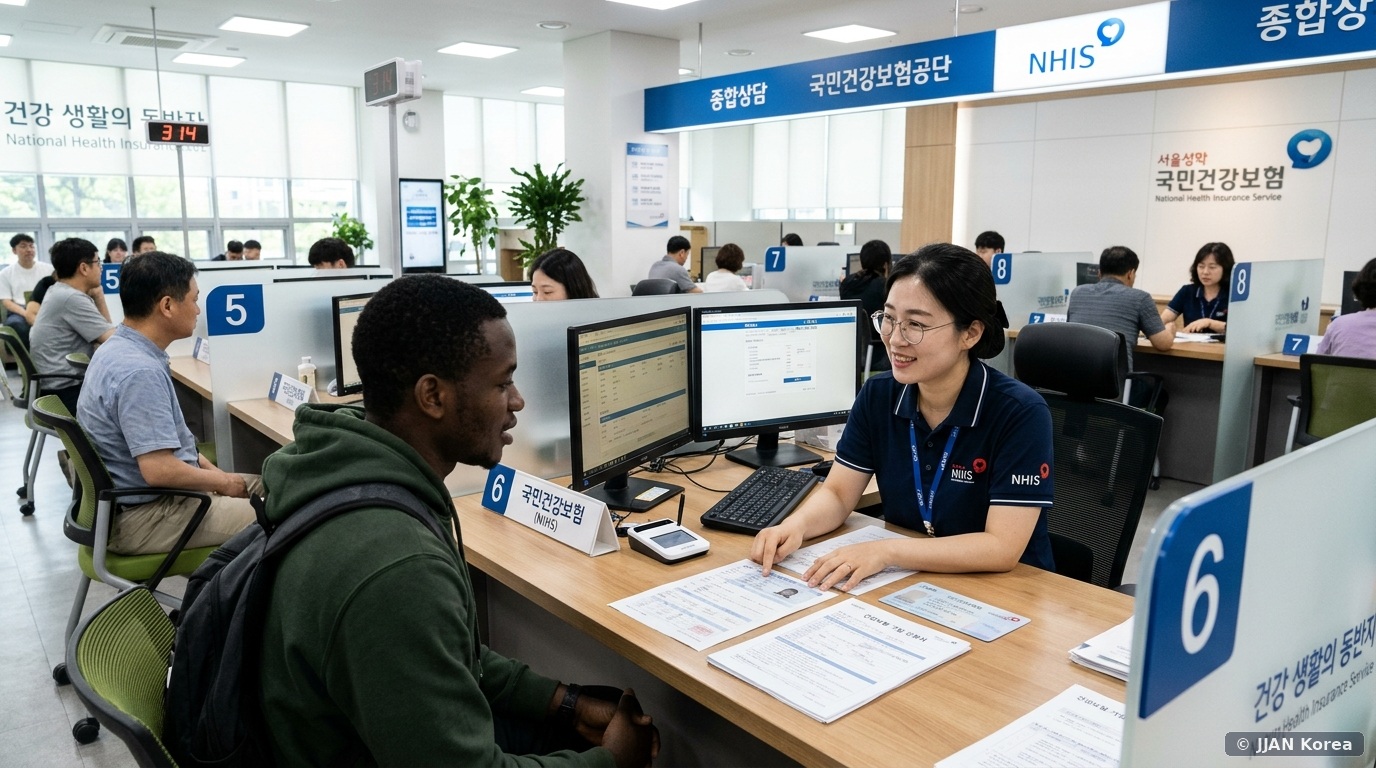

South Korea’s public healthcare architecture is celebrated globally for delivering ultra-modern medical technology, rapid specialist consultations, and extraordinarily low out-of-pocket costs. At the bedrock of this universal system sits the National Health Insurance Service (NHIS / 국민건강보험공단), a centralized, single-payer social insurance network that covers more than 97% of the nation’s domestic population.
For foreign residents, international students, and foreign corporate employees, enrollment in the NHIS is not an optional luxury—it is legally mandatory under the National Health Insurance Act. Failing to pay monthly insurance contributions results in automatic immigration penalties, the immediate freezing of your Alien Registration Card (ARC), and the outright denial of visa extensions at HiKorea. This exhaustive, field-verified manual breaks down mandatory enrollment timelines, premium calculation formulas, free annual health screenings, and dental scaling subsidies in 2026.
1. Mandatory Enrollment Rules & Automatic Eligibility Timelines
Under Article 109 of the National Health Insurance Act, foreign nationals residing in Korea are automatically categorized into one of two enrollment structures:
| Insurance Classification | Target Visa Categories | Enrollment Effective Date | Monthly Premium Calculation |
|---|---|---|---|
| Employee Insured (직장가입자) | E-1 through E-7 professional work visas, legally employed F-series residents | First official day of registered employment | 7.09% of gross monthly salary (Split exactly 50/50 between employer and employee; 3.545% deducted from paycheck) |
| Self-Employed / Regional Insured (지역가입자) | D-2 students, D-4 trainees, D-10 job seekers, freelance F-visas, digital nomads | Exactly 6 months from port of entry date (Or immediately upon ARC registration for D-2 degree students) | Statutory average monthly contribution (Approx. ₩150,000/month for adults; students receive special 50% discount to approx. ₩75,000/month) |
2. Severe Legal Penalties for Unpaid Insurance Premiums
The Ministry of Justice and the NHIS operate an integrated real-time data bridge. If you neglect monthly insurance payment notices arriving at your residence:
- Loss of Medical Co-Pay Coverage: The moment your overdue balance exceeds two consecutive billing cycles, the NHIS automatically freezes your insurance account. If you visit a clinic or hospital, you will be billed 100% full un-subsidized medical charges.
- HiKorea Visa Extension Lockout: When you apply to renew your visa (D-2, D-10, E-7, etc.), immigration officers pull your live NHIS account record. If you owe a single Won of delinquent health insurance, your visa extension will be rejected until the entire back-balance plus statutory interest penalties is settled in full.
- Asset & Bank Account Freezing: Under Korean administrative law, the NHIS possesses the legal authority to freeze your Korean bank accounts and seize tax refunds without a court order to recoup delinquent public insurance fees. To keep your banking active, consult our guide to opening and managing a Korean bank account.
3. The Korean Healthcare Co-Pay System: What You Actually Pay
Once insured under the NHIS, you do not need to file complex paperwork or reimbursement claims after seeing a doctor. You simply hand your Alien Registration Card (or state your 13-digit registration number) at any hospital reception desk. The computer automatically deducts the government subsidy, and you pay only the nominal patient co-pay at the cashier:
- Neighborhood Primary Clinics (의원 / Neighborhood Specialists): You pay only 20% to 30% of the total consultation fee. A standard visit to a board-certified internal medicine clinic, ENT doctor, or dermatologist typically costs between ₩5,000 and ₩10,000 total.
- Prescription Medications at Pharmacies: Standard generic prescription medicines for colds, infections, and allergies are subsidized by approximately 70%. A 3-day supply of antibiotics and cough remedies typically costs ₩3,000 to ₩6,000.
- Secondary General Hospitals (종합병원): Patient co-pays range between 40% and 50% of covered treatments.
- Tertiary University Teaching Hospitals (상급종합병원): Patient co-pay is approximately 50% to 60%. Note that you must present an official Medical Referral Slip (진료의뢰서) issued by a neighborhood clinic to access subsidized university care; walking in without a referral triggers full out-of-pocket pricing. In emergencies, review our guide to calling 119 and emergency room triage in Korea.
4. Hidden Benefits: Subsidized Annual Dental Scaling & Health Checkups
Many foreign residents never utilize the exceptional statutory wellness benefits funded by their monthly contributions:
Annual ₩15,000 Dental Scaling Subsidy
Under NHIS guidelines, every registered foreign national aged 19 and older is entitled to one comprehensive professional ultrasonic dental scaling treatment per calendar year (January 1 to December 31). While private dental cleanings cost ₩60,000 to ₩100,000, your NHIS co-pay reduces the total fee to approximately ₩15,000 at any licensed dental clinic across South Korea. Unused annual benefits do not roll over to the next year.
Free Biennial General Health Screening (일반건강검진)
Insured foreign residents are eligible for a 100% free comprehensive physical medical checkup every two years (odd-numbered birth years in odd years; even birth years in even years). Conducted at designated health screening centers, the government covers blood panels, liver function tests, kidney metrics, chest X-rays, blood pressure, and vision/hearing evaluations. If aged 40 or older, free gastrointestinal endoscopies and cancer screenings are included.
5. Step-by-Step Payment Setup: Automatic Bank Debit (자동이체)
To avoid missing monthly paper payment slips arriving in your mailbox, set up automated bank transfers immediately:
6. Frequently Asked Questions (FAQ)
Can I opt out of the NHIS if I hold private international travel insurance?
Generally, no. Under statutory revisions enacted by the National Assembly, private overseas travel insurance or international health policies do NOT exempt foreign residents from mandatory NHIS enrollment. The only rare exceptions apply to foreign government diplomats, personnel stationed under bilateral Social Security Totalization Agreements (e.g., specific corporate intra-company transferees), or employees covered by an employer-sponsored health plan matching all statutory NHIS benefit levels.
What happens to my NHIS coverage when I temporarily travel outside Korea?
If you depart South Korea for a temporary vacation or business trip lasting less than one continuous month, your health insurance coverage remains active, and you must continue paying monthly premiums. If you depart Korea and remain abroad for one full continuous calendar month or longer, your insurance premium billing is automatically suspended starting the month following your departure, and reactivates immediately upon re-entering the country.
Does NHIS cover mental healthcare and psychotherapy?
Yes. Consultations, diagnostic evaluations, and prescription psychiatric medications provided by board-certified psychiatrists (정신건강의학과) are covered under the standard NHIS co-pay framework (typically 30% to 40% patient co-pay). Non-medical talk therapy provided by private, unaccredited counseling centers is not covered.
Can I add my non-working spouse or children as dependents?
Yes. If you are enrolled as an Employee Insured worker (직장가입자), you can register your legal spouse and minor children as dependents (피부양자) free of charge. You must submit certified, apostilled marriage and birth certificates accompanied by certified Korean translations to an NHIS branch office.
🛡️ JJAN Korea Editorial Standards & Fact-Checking Verification
This article was independently researched, field-tested, and audited by the JJAN Korea Finance & Social Welfare Desk in Seoul. Audited in direct collaboration with the National Health Insurance Service (NHIS) International Center in Seoul; premium formulas verified against the 2026 NHIS Statutory Schedules.
Notice an unlisted policy change, fare update, or revised administrative rule? Help us keep our international community accurately informed: Submit a Correction to our Seoul Newsroom.