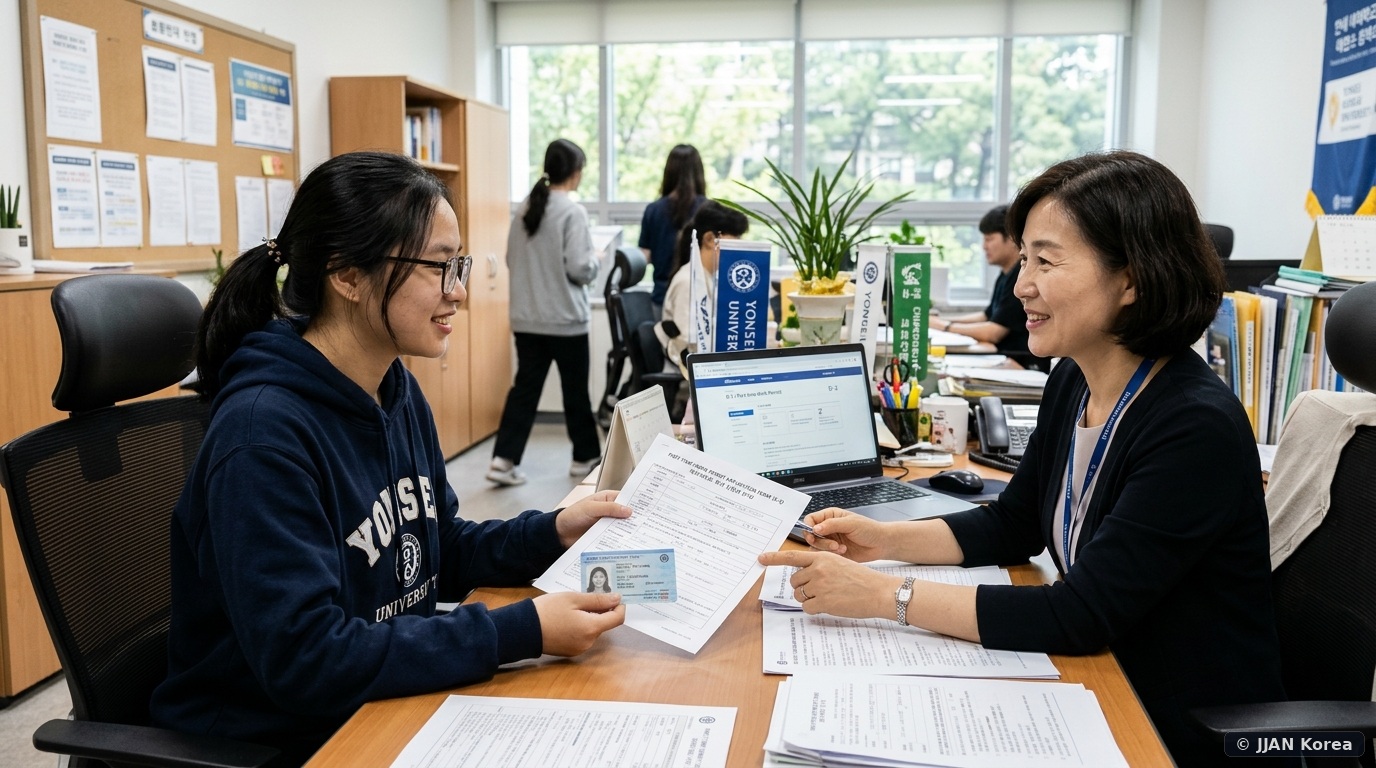
With over 200,000 international students pursuing undergraduate degrees, master’s programs, doctoral dissertations, and intensive Korean language training across South Korea, part-time employment (아르바이트 / Alba) is an essential way to offset living costs and gain valuable professional experience. However, under South Korean immigration law, holding an international student visa—whether D-2 (Degree Seeking) or D-4 (General Training / Language Trainee)—does NOT grant automatic working authorization.
Under Article 20 of the South Korean Immigration Act (출입국관리법), performing any form of paid labor or commercial activity without formal, prior government permission constitutes Illegal Employment (불법취업). The Ministry of Justice (MOJ) enforces stringent administrative penalties, including immediate visa revocation, mandatory deportation orders, multi-year entry bans, and criminal fines against both the student and the employer. To work legally, every foreign student must secure a Part-Time Work Permit for International Students (시간제취업 허가 / S-3) before their first shift. Below is the comprehensive, field-verified legal guide to obtaining your legal work permit, understanding weekly hourly ceilings based on your TOPIK level, identifying strictly prohibited industries, navigating vacation full-time work, understanding tax withholdings, and submitting your application through HiKorea.
1. Eligibility Requirements & The TOPIK Korean Language Tier System
The Ministry of Justice calibrates permitted weekly working hours based strictly on the student’s academic standing, semester level, and verified Korean language proficiency (Test of Proficiency in Korean / TOPIK, or KIIP Social Integration Program level). Students who demonstrate strong Korean capabilities are granted expanded hourly permissions, whereas those without language certification face severely restricted work allowances:
| Visa Category & Academic Level | Korean Requirement (TOPIK / KIIP) | Semester Hourly Limit (Mon–Fri) | Vacation Limits (Summer / Winter) |
|---|---|---|---|
| D-4 Language Trainee (After 6 Months) | TOPIK Level 2 or higher | Up to 20 hours / week | Up to 20 hours / week (No unlimited cap) |
| D-2 Undergraduate (1st & 2nd Year) | TOPIK Level 3 or higher | Up to 20 – 25 hours / week | Unlimited (Full-time allowed) |
| D-2 Undergraduate (3rd & 4th Year) | TOPIK Level 4 or higher | Up to 25 – 30 hours / week | Unlimited (Full-time allowed) |
| D-2 Graduate (Master’s & Doctoral) | TOPIK Level 4 / English Track (IELTS/TOEFL) | Up to 30 – 35 hours / week | Unlimited (Full-time allowed) |
| Students Failing TOPIK Threshold | Below required tier / Expired | Capped at 10 hours / week (50% reduction) | Capped at 10 hours / week (No vacation bonus) |
Academic Standing Prerequisite: Under Ministry of Justice guidelines, students must maintain a cumulative Grade Point Average (GPA) of 2.0 or higher (on a 4.5 scale) and attendance rates exceeding 70% in preceding semesters. If a student’s GPA falls below 2.0, the university international office is legally prohibited from endorsing the work permit application. Furthermore, students who have exceeded the regular semester duration (초과학기자 / semester extension students) face strict restrictions unless they are enrolled in active thesis preparation.
2. Permitted vs. Strictly Prohibited Work Sectors
Even with an approved S-3 work permit, international students cannot work in every industry. South Korean immigration statutes designate strict sectoral boundaries:
A. Permitted Employment Fields
- Hospitality & Dining: Baristas, café staff, casual restaurant servers, and kitchen assistants.
- Retail & Sales: Convenience store clerks, supermarket cashiers, and retail apparel sales associates.
- Translation & Interpretation: Document translation, tourist interpretation, event coordination, and bilingual office administration.
- Academic Support: Campus library assistants, university departmental administrative support, and research laboratory student assistants.
- Tour Guides & Duty-Free Retail: Assisting foreign tourists at retail shopping outlets and licensed travel agencies.
B. Strictly Prohibited Work Sectors (Zero Tolerance)
- Manufacturing & Industrial Assembly Lines (제조업): International students are strictly prohibited from working in manufacturing plants, industrial factories, or assembly lines, even on weekends or during vacation periods. Performing manual assembly or factory labor triggers immediate visa revocation and mandatory departure.
- Construction Sites (건설업): Manual labor or civil engineering assistance at construction sites is completely prohibited due to safety and immigration statutes.
- Adult Entertainment & Nightlife (유흥업소): Hostess bars, private karaoke establishments (noraebang servers), massage parlors, adult game rooms, and nightlife venues.
- Motorized Delivery Couriers (배달대행): Operating motorbikes or electric scooters for food delivery apps like Baemin, Coupang Eats, or Yogiyo is illegal on student visas due to high road traffic accident risks.
- Private Tutoring & Language Lessons (개인과외교습): Under the Act on the Establishment and Operation of Private Teaching Institutes, foreign nationals cannot conduct unaccredited private tutoring in personal residences or cafés.
3. Step-by-Step Procedure: Securing the Part-Time Work Permit (S-3)
You must obtain your approved permit BEFORE your first shift. Working while your application is pending review is legally considered unauthorized employment. Follow these exact steps:
Step 1: Secure a Job Offer & Complete the S-3 Form
Interview and receive a formal job offer. Have the employer complete and sign the official Part-Time Work Permit Form for Foreign Students (시간제취업 확인서). The form specifies company business registration number, hourly wage (which must comply with the 2026 Korean Minimum Wage of 10,030 KRW), exact working days, and job responsibilities.
Step 2: Obtain University International Office Endorsement
Take the completed S-3 form, your official transcript, and your TOPIK certificate to your university’s International Student Support Team (외국인유학생지원센터). An authorized university officer reviews your GPA and attendance, signs the confirmation box, and logs the endorsement in the immigration university portal.
Step 3: Submit via HiKorea E-Application (Free Online Filing)
Log in to hikorea.go.kr, navigate to E-Applications > Permission for Activities Outside Status of Stay (체류자격 외 활동허가), and upload scanned copies of:
- Signed Part-Time Work Permit Form (시간제취업 확인서) with university stamp.
- Copy of Employer’s Business Registration Certificate (사업자등록증 사본).
- Standard Employment Contract (표준근로계약서).
- Valid Alien Registration Card (ARC) copy.
- Official TOPIK or KIIP scorecard.
Step 4: Receive Digital Approval & Keep On-Site Proof
Processing takes 3 to 7 business days. Upon approval, download and print the official Permission Confirmation Notice (허가확인서). Keep a physical copy at your workplace to present in the event of an immigration inspection. Failure to produce this permit during a surprise audit creates an initial presumption of illegal labor.
4. Tax Withholding for Students: 3.3% Freelance vs. Four Major Insurances
International student workers must understand how earnings are taxed under South Korean law:
- Daily / Part-Time Wage Deduction (일용직 / 알바): If working under 15 hours per week or on short-term shifts, earnings are typically subject to simplified income tax with zero income tax liability if daily pay is under 150,000 KRW.
- 3.3% Business Freelance Withholding (3.3% 사업소득): Many restaurant and café owners erroneously register students as independent contractors, deducting 3.3% withholding tax. If registered this way, the employer reports your earned income to the National Tax Service under your ARC number. If you did not secure an approved S-3 permit for that business number, the NTS data exchange automatically alerts immigration authorities, resulting in visa extension holds during the next semester.
- Four Major Social Insurances (4대보험): Students working more than 15 hours per week (or 60 hours per month) are legally eligible for Industrial Accident Compensation Insurance (산재보험) and Employment Insurance, but are generally exempt from mandatory National Pension if enrolled in active university studies.
5. Graduation Transition: Upgrading from D-2 to D-10 Job Seeker & E-7 Work Visa
Part-time work during university builds the foundation for long-term career transition in Korea:
- D-10-1 Job Seeker Visa: Upon graduation, international students with a bachelor’s or master’s degree can transition to the D-10 Job Seeker Visa (구직비자) under a points-based evaluation matrix (evaluating age, academic degree, TOPIK level, and Korean university background). D-10 visa holders can participate in corporate internships for up to 6 months per company.
- E-7 Foreign National of Special Ability Visa: When a Korean company extends a full-time corporate job offer matching your academic major (e.g., software engineering, global marketing, trade, design), you can sponsor an E-7 visa. Graduating from a domestic Korean university waives the standard 1 to 5-year overseas work experience requirement, providing a streamlined path to full professional residency.
6. Crucial Documentation Checklist for Student Workers
- Part-Time Work Permit Form (시간제취업 확인서): Signed by employer, university advisor, and applicant.
- Standard Labor Contract (표준근로계약서): Listing statutory wages, working hours, and rest intervals.
- Business Registration Certificate (사업자등록증): Proving the business is legally operating and not in a prohibited sector.
- Valid Alien Registration Card (ARC): With updated residential address reported within 15 days as detailed in our Residence Change Reporting Guide.
- University Academic Transcript & Attendance Record: Demonstrating GPA 2.0+ and 70%+ attendance.
- Valid TOPIK Scorecard: Must be within the 2-year validity window on submission date.
7. Frequently Asked Questions (FAQ)
Q1. Can a D-4 Language Trainee work immediately upon arriving in Korea?
No. Under immigration regulations, D-4 language training visa holders must complete at least 6 months (two full terms) of study in South Korea before becoming eligible to apply for a part-time work permit. During the initial 6 months, all employment is strictly prohibited.
Q2. Can I work at two different part-time jobs simultaneously?
Yes, but you must register both workplaces separately. The combined total hours across both jobs cannot exceed your statutory weekly hourly limit (e.g., 20 or 25 hours per week). Each employer must sign an S-3 confirmation form, and both locations must be formally registered and approved on your immigration record.
Q3. What are the legal penalties if I am caught working without a permit?
If caught during a joint immigration inspection (합동단속):
- First Violation: Fined between 1,000,000 KRW and 3,000,000 KRW; prohibited from obtaining a work permit for 1 year.
- Second Violation / Serious Breach (e.g., working in manufacturing or adult entertainment): Immediate cancellation of your student visa (D-2/D-4), issuance of an official Deportation Order (출국명령 / 강제퇴거), and a minimum 1 to 3-year entry ban into South Korea.
Q4. Is university internship work covered under the S-3 permit?
If the internship is an accredited, credit-bearing component of your university academic curriculum (학점연계 인턴십), it is classified as academic training and generally does not require a commercial S-3 work permit. However, non-credit paid corporate internships require formal prior consultation with immigration authorities.
JJAN Korea Policy & Legal Verification Desk
Regulatory Reference: Immigration Act (출입국관리법) Article 20 (Activities Outside Status of Stay) & Article 94 (Penal Provisions), and Ministry of Justice International Student Visa & Stay Management Guidelines.
Verification Authority: Republic of Korea Ministry of Justice (법무부 출입국·외국인정책본부) & National Institute for International Education (NIIED).