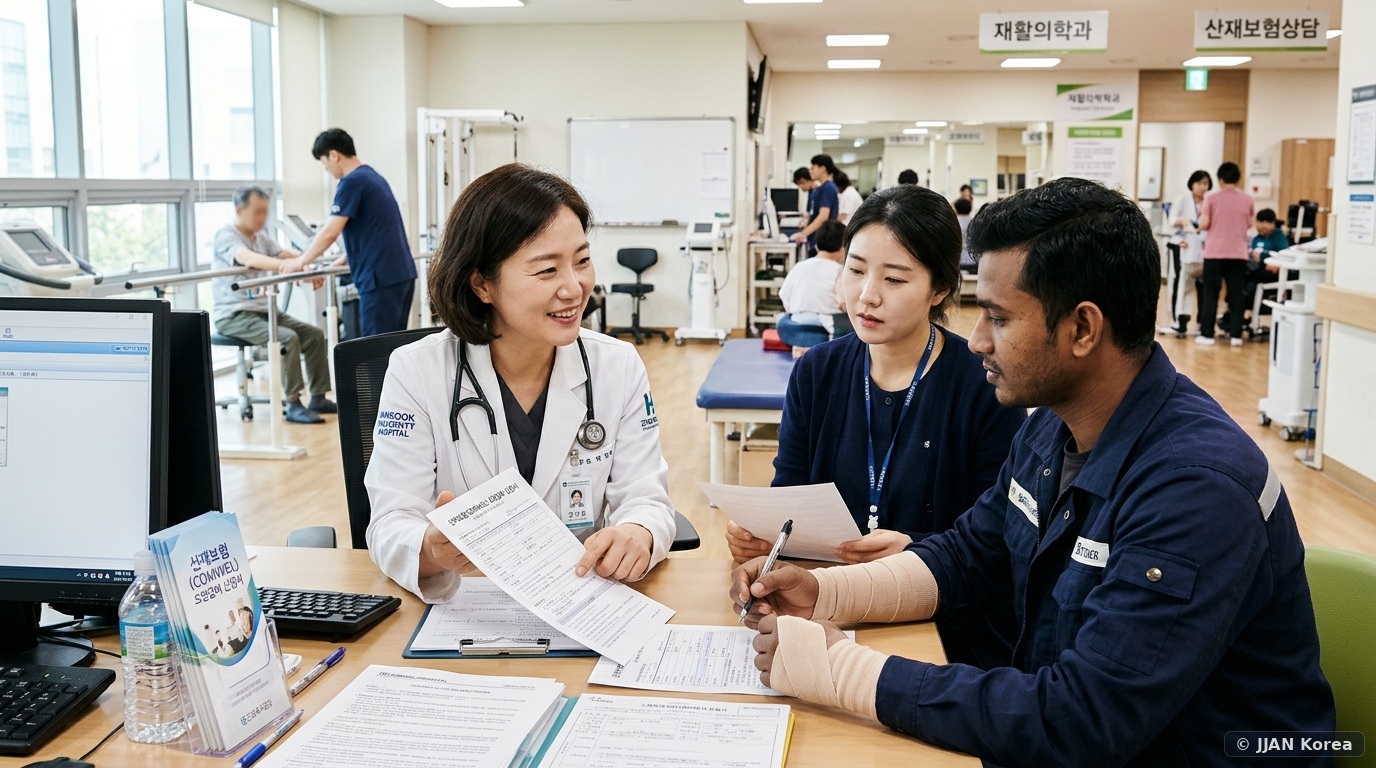
Workplace safety is an inherent human right that transcends national borders, language barriers, and immigration classifications. Every day, hundreds of thousands of foreign workers power South Korea’s manufacturing plants, agricultural farms, logistics fulfillment centers, maritime shipyards, and heavy construction sites. When a sudden workplace injury, industrial fall, chemical burn, or occupational illness occurs, navigating medical treatment and insurance claims can feel overwhelming—especially when fears of dismissal or deportation arise.
Under South Korean labor jurisprudence and the Industrial Accident Compensation Insurance Act (산업재해보상보험법), foreign workers enjoy comprehensive, universal legal protection. Crucially, established Supreme Court precedents affirm that even undocumented foreign workers (불법체류자) are 100% entitled to statutory industrial accident benefits. Furthermore, South Korean law strictly prohibits medical institutions from reporting injured undocumented patients to immigration authorities during treatment. Below is the definitive legal guide to securing full medical coverage (요양급여), claiming temporary disability wage replacement (휴업급여), defending against employer interference (공상처리), understanding occupational illnesses, and filing claims directly with the Korea Workers’ Compensation & Welfare Service (근로복지공단 COMWEL).
1. The Universal Legal Protection Principle: Nationality & Visa Status Neutrality
Article 5 of the Industrial Accident Compensation Insurance Act mandates that insurance protections apply to every business or workplace employing workers nationwide. Under South Korean constitutional law and landmark Supreme Court rulings (Supreme Court Decision 94No2777), an employee’s legal right to industrial accident compensation is grounded in their factual status as a laborer who performed work under an employer’s instruction, entirely independent of their administrative immigration status.
This principle establishes three non-negotiable legal protections:
- Universal Coverage: E-9, E-7, H-2, E-8, F-visa holders, student workers, and undocumented workers are equally protected by statutory insurance.
- Employer Non-Enrollment Immunity: Even if your employer broke the law by failing to register you for the Four Major Social Insurances (4대보험) or failing to pay insurance premiums, you are still 100% covered. COMWEL pays all your medical benefits and compensation directly, and subsequently recovers statutory penalty funds from the delinquent employer.
- Strict Prohibition on Immigration Reporting: Under Article 84, Paragraph 2 of the Enforcement Decree of the Immigration Act, medical personnel, public health doctors, and civil servants assisting with emergency medical treatment and industrial accident compensation are exempt from the duty to notify immigration authorities regarding an injured patient’s immigration status. You cannot be arrested at the hospital bed while receiving medical care.
2. The Statutory Benefits Package: What Does Sanjae Cover?
When an industrial accident claim (산재신청) is approved by COMWEL, the injured worker is entitled to an extensive, government-backed financial compensation package:
| Statutory Benefit Category | Legal Basis & Calculation Standard | Coverage Description & Scope |
|---|---|---|
| Medical Care Benefit (요양급여) | Full Medical Coverage | 100% of emergency surgery, hospitalization, medication, diagnostic imaging (MRI/CT), physical therapy, and assistive prosthetics. |
| Temporary Disability Benefit (휴업급여) | 70% of Average Daily Wage | Paid for every calendar day the worker is medically unable to work during hospitalization and outpatient rehabilitation. |
| Disability Compensation (장해급여) | Grades 1 through 14 (Lump Sum or Pension) | Substantial financial compensation awarded if permanent functional impairment remains after medical treatment concludes. |
| Nursing Benefit (간병급여) | Actual Caregiver Expenses | Covers professional caregiver fees for severe injuries requiring constant or frequent personal assistance. |
| Survivors’ Benefits & Funeral Allowance (유족급여·장의비) | 1,300 Days Average Wage + Funeral Costs | Disbursed to the deceased worker’s surviving dependents abroad in the tragic event of a fatal workplace accident. |
3. Coverage for Occupational Illnesses, Chemical Exposure & Mental Health
Industrial accident protections extend far beyond physical machinery fractures or cuts. Under Article 37 of the Act, workers can claim compensation for progressive occupational diseases:
- Musculoskeletal Disorders (근골격계 질환): Lumbar disc herniation, rotator cuff tears, carpal tunnel syndrome, and chronic knee joint deterioration caused by repetitive lifting, heavy loading, or awkward postures over months of industrial work.
- Toxic Chemical Exposure & Respiratory Diseases: Skin dermatitis, toxic hepatitis, asthma, or chronic bronchitis resulting from handling industrial solvents, thinners, pesticides, or welding fumes without adequate ventilation.
- Workplace Harassment & Mental Health (직장 내 괴롭힘 산재): Severe clinical depression, panic disorders, or acute stress disorders resulting from proven verbal abuse, physical violence, or extreme workplace bullying by managers are legally recognized as compensable industrial illnesses under recent labor board directives.
4. Defending Against Illegal Private Settlements (공상처리)
One of the most dangerous traps encountered by injured foreign workers is the employer’s offer of an informal Private Settlement (공상 / Gong-sang). Under this tactic, an employer promises to pay immediate hospital bills in exchange for the worker agreeing not to report the accident to COMWEL.
Never accept an informal private settlement without legal counsel. Private settlements are heavily favored toward the employer and carry immense legal hazards:
- Future Medical Relapses: Private settlements do not cover secondary complications, surgical revisions, or long-term physical therapy months down the road. Once the informal money runs out, the hospital bills fall entirely on you.
- Forfeiture of Disability Compensation: Only an official COMWEL Sanjae ruling grants statutory permanent disability compensation (장해급여), which can amount to tens of millions of won.
- Illegal Concealment of Accidents: Concealing an industrial accident (산재은폐) is a severe criminal offense under Article 170 of the Occupational Safety and Health Act, punishable by up to 1 year imprisonment or fines up to 10,000,000 KRW.
5. Real-World Case Study: Complete Rehabilitation and Compensation
Consider the documented case of Tariq, an E-9 foreign worker in a Hwaseong metal stamping plant. While operating a hydraulic press, an equipment failure crushed his left hand, causing multiple compound fractures. The employer initially offered 5,000,000 KRW in cash for private settlement and urged him not to visit a major hospital. Tariq contacted a local foreign worker support center, who escorted him to an accredited orthopedic hospital and filed a COMWEL Sanjae application.
COMWEL approved the claim in 12 days. The results were life-changing:
- 100% Hospital Coverage: Two major surgical procedures, 6 weeks of hospitalization, and 8 months of physical therapy totaling 22,000,000 KRW were fully paid by COMWEL.
- Monthly Wage Replacement: Tariq received 70% of his average monthly salary (approx. 1,950,000 KRW per month) throughout his 8-month rehabilitation.
- Disability Settlement: Following medical stabilization, COMWEL assessed a Grade 10 permanent functional impairment, awarding Tariq a statutory lump-sum disability benefit of 28,500,000 KRW.
- Protected Visa Status: Because his dismissal was legally barred during medical treatment, Tariq received full workplace transfer authorization once cleared to return to lighter duties.
6. Step-by-Step Procedure: Submitting Your Sanjae Claim to COMWEL
You do not need your employer’s permission, signature, or approval to apply for industrial accident compensation. Follow these steps:
Step 1: Seek Emergency Medical Care at a Sanjae-Designated Hospital
Visit an accredited hospital emergency room or orthopedic clinic. Inform the examining physician that your injury occurred during work duties. Request that the hospital’s medical affairs office prepare an official Initial Medical Examination Certificate for Industrial Accidents (산업재해 초진소견서).
Step 2: Complete the Application for Medical Care Benefits (요양급여신청서)
Obtain the official claim form from the hospital social work department, the COMWEL website (comwel.or.kr), or a regional Foreign Worker Support Center. Fill out the factual circumstances: date, time, physical location of the accident, machinery involved, and names of coworker witnesses.
Step 3: Submit to Regional COMWEL Branch
Submit the application and medical certificate to the COMWEL branch holding jurisdiction over your workplace. Most hospitals have dedicated Sanjae coordinators who submit this application electronically on your behalf directly through the COMWEL medical network.
Step 4: COMWEL Investigation & Approval
COMWEL assigns a claims adjuster who investigates the accident site, reviews hospital records, and requests a written statement from your employer. Even if the employer falsely denies the accident, COMWEL conducts independent factual verification. Upon approval, all hospital expenses are transferred directly to the medical facility, and temporary disability benefits are deposited into your bank account.
7. Frequently Asked Questions (FAQ)
Q1. Can my employer fire me while I am undergoing medical treatment for a workplace injury?
No. Under Article 23, Paragraph 2 of the Labor Standards Act, an employer is strictly prohibited from dismissing an employee during the period of medical treatment for an occupational injury or disease, and for 30 days thereafter. Any termination during this statutory protection period is legally void and constitutes criminal unlawful dismissal.
Q2. If an undocumented worker applies for Sanjae, will immigration deport them immediately?
No. When an undocumented foreign worker sustains a workplace injury and applies for Sanjae, immigration authorities grant a humanitarian G-1 Temporary Visa (Medical Treatment Visa / G-1-1) upon application. This G-1 status allows the injured worker to remain legally in South Korea throughout their hospitalization and rehabilitation until treatment and disability compensation payouts are concluded.
Q3. Are accidents occurring during daily commuting (출퇴근 재해) covered by Sanjae?
Yes. Under Article 37 of the Industrial Accident Compensation Insurance Act, accidents occurring while traveling between your residential domicile and workplace via standard routes and transportation methods (subway, bus, walking, personal car, or company shuttle) are recognized as industrial commuting accidents (출퇴근 재해) with full benefits.
Q4. Which organization provides free translation and legal support for Sanjae claims?
Injured workers can contact COMWEL Multilingual Counseling at 1588-0075, the Korea Support Center for Foreign Workers at 1644-0644, or local migrant worker labor advocacy centers for pro bono labor attorney representation.
JJAN Korea Policy & Legal Verification Desk
Regulatory Reference: Industrial Accident Compensation Insurance Act (산업재해보상보험법) Articles 5, 37, 40, 52 & 57, Labor Standards Act Article 23, and Enforcement Decree of the Immigration Act Article 84.
Verification Authority: Republic of Korea Korea Workers’ Compensation & Welfare Service (근로복지공단 COMWEL) & Ministry of Employment and Labor (고용노동부).