In South Korea, the arrival of autumn heralds Chuseok (추석 / Korean Thanksgiving)—the country’s most cherished holiday season dedicated to harvest, family reunions, and sharing prosperity. However, for foreign workers whose employers fail to disburse earned wages or statutory holiday bonuses, the pre-Chuseok period can bring severe financial and emotional distress. To protect vulnerable workers and ensure holiday economic stability, the Ministry of Employment and Labor (MOEL) conducts annual nationwide intensive inspections against wage delinquency.
Critically, when a company experiences severe financial distress, corporate insolvency, or outright refuses to pay back wages, the South Korean government provides a powerful legal safety net: the Government Emergency Substitute Payment Scheme (간이대지급금 / Simplified Daejigeubgeum). Under Article 7 of the Wage Claim Guarantee Act (임금채권보장법), the Korea Workers’ Compensation & Welfare Service (근로복지공단 COMWEL) advances unpaid wages and retirement severance directly to foreign workers out of state funds, and subsequently files subrogation lawsuits against the delinquent business owner. Below is the definitive legal walkthrough to claiming up to 10,000,000 KRW in emergency government substitute payments, understanding fast-track dispute timelines, defending your worker rights before Chuseok, and executing legal claims against defaulting employers.
1. The 2026 Emergency Substitute Payment Framework (간이대지급금)
Historically known as “Small-Scale Sovereign Payouts (소액체당금)”, the Simplified Substitute Payment system was created to eliminate the lengthy 6 to 12-month court trials previously required to claim unpaid earnings. Today, foreign employees can receive direct financial relief from the state within weeks of establishing employer delinquency:
| Claim Category & Type | Statutory Maximum Payout Cap | Eligible Period of Labor |
|---|---|---|
| Unpaid Wages Component (임금) | Up to 7,000,000 KRW | Final 3 months of unpaid regular wages and allowances. |
| Unpaid Retirement Severance (퇴직금) | Up to 7,000,000 KRW | Final 3 years of unpaid statutory retirement severance pay. |
| Combined Total Maximum Ceiling | Up to 10,000,000 KRW | The statutory maximum for simplified claims across both categories. |
| Court Judicial Payouts (일반대지급금) | Up to 21,000,000 KRW | Applicable when an employer enters formal bankruptcy court proceedings. |
Universal Worker Protection: Just as established in our Universal Industrial Accident Coverage Guide, the Wage Claim Guarantee Act applies to all employees regardless of nationality or legal visa status. Even undocumented foreign workers who have suffered wage theft possess the absolute statutory right to apply for and receive Simplified Daejigeubgeum compensation.
2. The Fast-Track 3-Step Procedure: From Labor Board to Direct Deposit
Unlike complex civil litigation, the Simplified Daejigeubgeum process is streamlined to disburse emergency funds swiftly:
Step 1: File a Wage Violation Petition with MOEL (임금체불 진정)
Report to the regional Ministry of Employment and Labor office (지방고용노동관서) governing your workplace. Submit a petition detailing unpaid wages. A labor inspector summons your employer, audits company accounting books, and verifies the exact unpaid sum. If the employer fails to appear after two formal summons, the labor inspector conducts an ex officio audit based on bank records and time cards.
Step 2: Obtain Confirmation of Unpaid Wages (체불임금등·사업주확인서)
Once the labor inspector confirms the violation, request the vital legal document: the official Confirmation of Unpaid Wages and Business Owner Status (체불임금등·사업주확인서). This document serves as definitive judicial proof of your wage claim, completely eliminating the need to hire a private lawyer or file a lawsuit in court.
Step 3: Submit Direct Claim to COMWEL
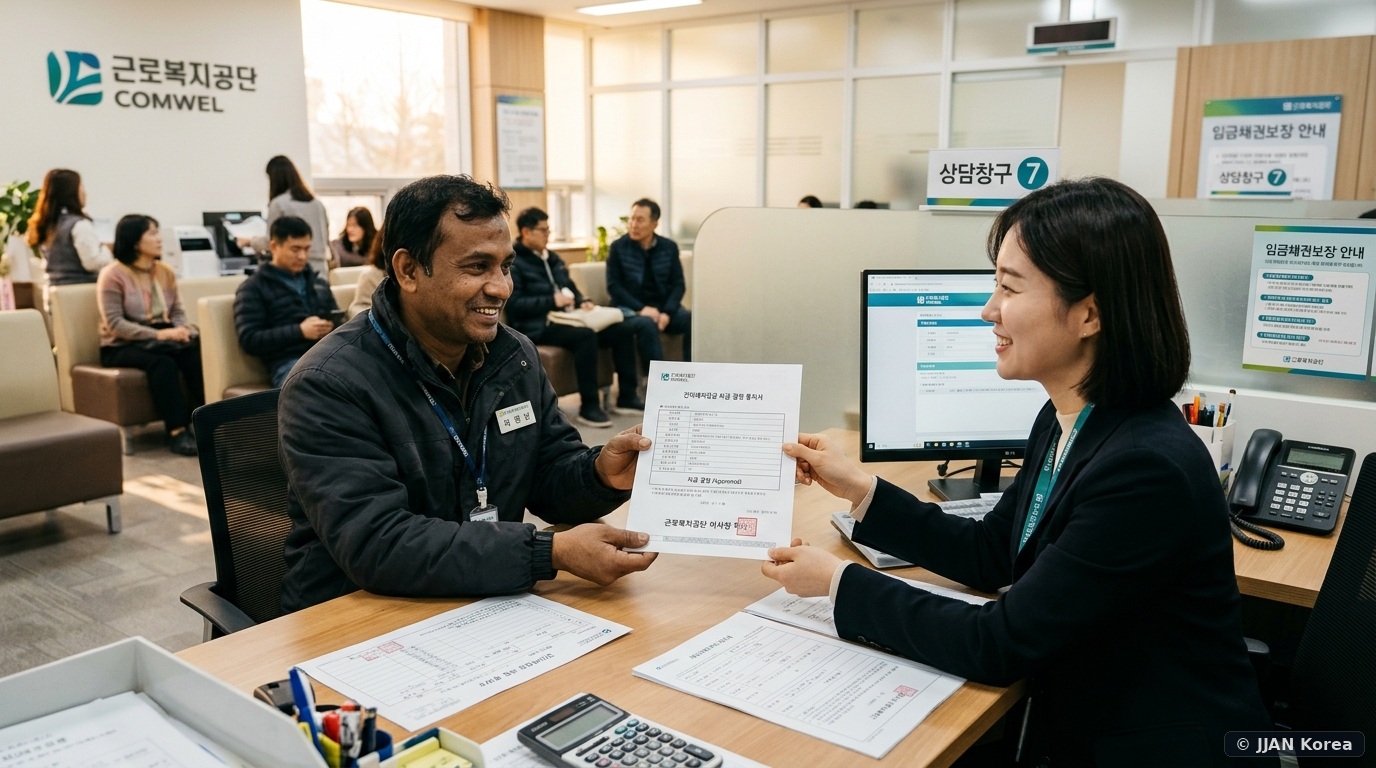
Submit your application and the MOEL confirmation certificate to the Korea Workers’ Compensation & Welfare Service (근로복지공단 COMWEL) branch office or online via the labor welfare portal. Within 14 days of verification, COMWEL transfers up to 10,000,000 KRW directly into your personal Korean bank account.
3. Statutory Criminal Penalties & The 20% Delayed Interest Mandate
South Korean labor law imposes harsh punitive consequences on employers who default on worker wages. Under Article 36 of the Labor Standards Act (근로기준법), when an employee leaves a company, the employer must disburse all earned wages, retirement allowances, and compensation within 14 days of the date of departure, unless an explicit written extension agreement exists.
If the employer fails to disburse payment within this statutory 14-day window:
- Criminal Prosecution: The business owner faces criminal indictment under Article 109 of the Labor Standards Act, carrying penalties of up to 3 years imprisonment or criminal fines up to 30,000,000 KRW. Repeat offenders face public disclosure of personal names and credit freezes.
- 20% Annual Delayed Interest (지연이자제): Under Article 37 of the Labor Standards Act, any unpaid wages and retirement pay accrued after the 14-day mark are legally subject to a statutory punitive interest rate of 20% per annum until fully settled. This interest rate is mandated by presidential decree and cannot be waived by company rules.
4. Super-Priority Wage Claims in Bankruptcy (임금채권 최우선변제권)
Foreign workers often fear that if their factory or restaurant collapses into bankruptcy, senior corporate creditors such as commercial banks will take all remaining assets. Under Article 38 of the Labor Standards Act and Article 8 of the Commercial Code, unpaid wages enjoy Super-Priority Status (최우선변제권):
- The final 3 months of wages and the final 3 years of retirement severance are legally prioritized ahead of all general tax liens, government duties, corporate mortgages, and secured commercial bank loans.
- When company real estate, machinery, or bank accounts are liquidated in court auctions, foreign workers’ wage claims are paid out first before a single won is given to mortgage holders.
5. Simplified Daejigeubgeum vs. General Insolvency Daejigeubgeum
The Wage Claim Guarantee Act establishes two distinct tracks for government wage advancement:
- Simplified Substitute Payment (간이대지급금): Designed for active businesses that are operating but failing to pay wages, or companies that recently shut down. Requires only a labor inspector’s Confirmation of Unpaid Wages (체불임금확인서). Capped at 10,000,000 KRW (up to 7M for wages, up to 7M for severance). Processing takes approximately 14 business days.
- General Insolvency Substitute Payment (도산대지급금): Designed for companies entering formal court bankruptcy (파산선고) or certified de facto insolvency (도산등사실인정) by the labor board. Provides significantly higher compensation ceilings (up to 21,000,000 KRW based on worker age brackets) covering the final 3 months of wages and final 3 years of severance.
6. Free Legal Representation via Korea Legal Aid Corporation (대한법률구조공단)
If your unpaid wage claim exceeds the 10,000,000 KRW government cap, you can pursue the remaining balance through civil court execution. Under a cooperative agreement with the Ministry of Employment and Labor, the Korea Legal Aid Corporation (대한법률구조공단 KLAC) provides 100% free legal representation and court litigation support to foreign workers whose average monthly income is under 4,000,000 KRW.
A dedicated KLAC public attorney will file property seizure orders (가압류) against the employer’s factory equipment, corporate bank accounts, and real estate, and execute civil collection orders at zero legal cost to the foreign worker.
7. Real-World Case Study: Recovering 8.4 Million Won in 18 Days Before Chuseok
Consider the case of Michael, an E-9 technician from the Philippines working at an automotive parts manufacturer in Gimpo. In late August, the factory owner announced that due to export delays, July and August salaries (5,400,000 KRW) and accrued severance upon Michael’s contract completion (3,000,000 KRW) could not be paid before the upcoming Chuseok holiday.
Instead of waiting passively, Michael followed standard statutory relief steps:
- On September 1, he visited the Bucheon Regional Employment and Labor Office with his bank passbook and standard labor contract, filing a wage delinquency petition.
- The labor inspector conducted an expedited tripartite audit on September 7. The employer signed an acknowledgment of 8,400,000 KRW in unpaid compensation.
- On September 10, the labor inspector issued Michael an official Confirmation of Unpaid Wages (체불임금확인서).
- Michael submitted the certificate online to COMWEL for Simplified Daejigeubgeum.
- On September 18—one week before Chuseok—COMWEL wired the full 8,400,000 KRW directly into Michael’s Woori Bank account. COMWEL subsequently launched recovery litigation against the factory owner.
8. Crucial Documentation Checklist for Unpaid Wage Claims
- Standard Labor Contract (표준근로계약서): Listing agreed wage rates, overtime formulas, and daily working hours.
- Bank Passbook Statement (통장 입출금내역): Documenting missing or partial salary transfers over the disputed months.
- Attendance Records: Photos of daily punch cards, mobile chat logs showing work orders, or coworker witness affidavits.
- Confirmation of Unpaid Wages (체불임금등·사업주확인서): The critical certificate issued by the MOEL labor inspector.
- Valid Korean Bank Account Passbook Copy: In the worker’s name for direct government deposit.
- Alien Registration Card (ARC) or Passport Copy: Proving worker identity.
9. Frequently Asked Questions (FAQ)
Q1. Can an undocumented foreign worker receive government Daejigeubgeum payments?
Yes. The Supreme Court of Korea has repeatedly affirmed that earned labor rights exist independently of administrative visa status. Undocumented foreign workers can receive Confirmation of Unpaid Wages from labor inspectors and collect up to 10,000,000 KRW in Simplified Daejigeubgeum from COMWEL without fear of arrest at labor offices.
Q2. How long do I have to file a claim after leaving the company?
Under the Wage Claim Guarantee Act, an employee must apply for Simplified Daejigeubgeum within 1 year from the date of contract termination (or within 6 months from the date the Confirmation of Unpaid Wages is issued). Do not delay filing your claim, as exceeding the statutory deadline extinguishes your right to government substitute payouts.
Q3. Does receiving Daejigeubgeum affect my Departure Guarantee Insurance (출국만기보험)?
Departure Guarantee Insurance (managed by Samsung Fire) and government Daejigeubgeum are coordinated under our analyzed Departure Insurance Severance Rules. If an employer failed to pay both monthly insurance and basic wages, the labor inspector calculates the net difference, ensuring you receive your full statutory compensation without double deductions.
Q4. Which emergency phone number handles unpaid wage reports before Chuseok?
Foreign workers can contact the Ministry of Employment and Labor Multilingual Center at 1350 (available in 18 languages) or call the Korea Support Center for Foreign Workers at 1644-0644 for emergency labor dispute intervention.
JJAN Korea Policy & Legal Verification Desk
Regulatory Reference: Wage Claim Guarantee Act (임금채권보장법) Article 7 (Payment of Substitute Wages) & Article 12, Labor Standards Act Articles 36, 37 & 43, and MOEL Pre-Chuseok Wage Delinquency Directive.
Verification Authority: Republic of Korea Ministry of Employment and Labor (고용노동부) & Korea Workers’ Compensation & Welfare Service (근로복지공단 COMWEL).