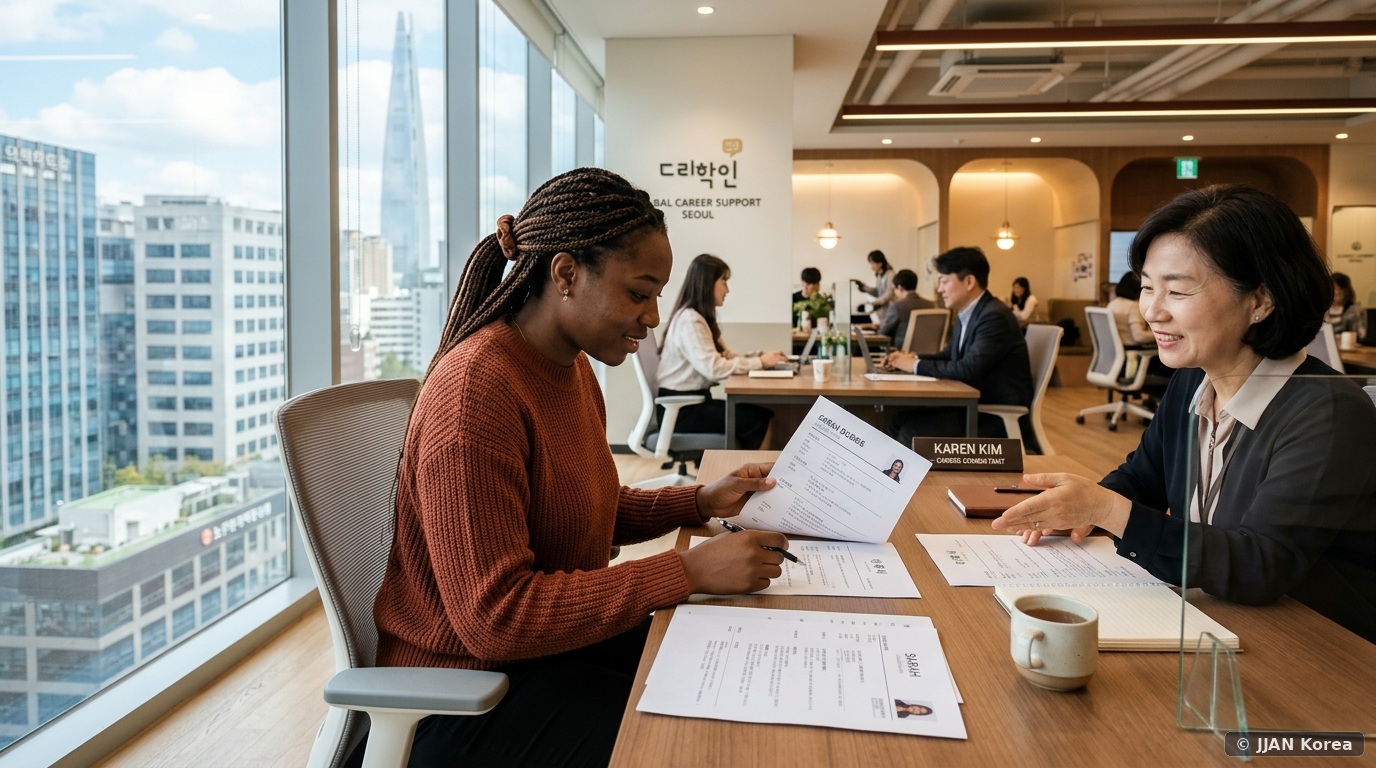
For international degree graduates completing university in South Korea, foreign tech talents, and skilled international professionals concluding an employment contract, the transition period between student life and corporate employment is fraught with administrative vulnerability. In the Republic of Korea, the moment your D-2 study visa or E-7 professional work visa expires, you must either depart the country or transition to a legal bridge status. That legal lifeline is the D-10-1 Job Seeker Visa (구직비자).
Designed to allow qualified foreign talent to legally reside in South Korea while interviewing, preparing startup ventures, or undertaking formal corporate internships, the D-10 is governed by a rigorous, merit-based Points-Based System (점수제) administered by the Ministry of Justice (법무부). Failing to tally your points correctly, submitting an inadequate 6-month job search plan, or violating strict internship reporting rules can lead to visa revocation and immediate departure orders. This comprehensive guide breaks down the 2026 points calculation matrix, HiKorea filing procedures, 6-month extension rules, and legal internship conversion protocols.
1. The 2026 D-10 Point System Matrix: Scoring Breakdown
Under Ministry of Justice immigration guidelines, applicants seeking a D-10-1 job search visa must score a minimum of 60 total points out of 190 available points. Crucially, you must earn at least 20 basic points from the mandatory foundational section (Age + Education Level) to qualify for consideration:
| Evaluation Category | Scoring Criteria & Qualifications | Maximum Point Cap |
|---|---|---|
| 1. Basic Points: Education Level (학력) | Doctoral Degree: 35 pts | Master’s Degree: 30 pts | Bachelor’s Degree: 20 pts | Associate Degree (Korean college only): 15 pts | 35 Points |
| 2. Basic Points: Age (연령) | Ages 20–24: 10 pts | Ages 25–29: 20 pts | Ages 30–34: 15 pts | Ages 35–39: 10 pts | Age 40+: 5 pts | 20 Points |
| 3. Select Points: Korean Study Experience | Korean University Doctoral Degree: 30 pts | Master’s Degree: 20 pts | Bachelor’s Degree: 15 pts | Associate Degree: 10 pts | Korean language training (1+ yr): 5 pts | 30 Points |
| 4. Select Points: Professional Work Experience | Domestic Korean E-7 professional experience (1–2 yrs: 5 pts; 2–3 yrs: 10 pts; 3+ yrs: 15 pts) | Overseas professional experience in eligible fields (1–2 yrs: 5 pts; 3+ yrs: 15 pts) | 15 Points |
| 5. Select Points: Korean Language Proficiency | TOPIK Level 6 or KIIP Stage 5: 20 pts | TOPIK Level 5 or KIIP Stage 4: 15 pts | TOPIK Level 4: 10 pts | TOPIK Level 3: 5 pts | 20 Points |
| 6. Bonus Points (가점) | Global Top 500 University Graduate (THE/QS rankings): 20 pts | Fortune Global 500 Work Experience (1+ yr): 20 pts | STEM Field Graduate: 5 pts | High-Income Professional: 5 pts | 70 Points |
Minimum Qualification Threshold: You must score at least 20 points in Basic Categories (Education + Age) AND achieve an aggregate total of 60 points or higher across all combined sections. If you score 15 points in basic sections, your application is automatically disqualified regardless of how high your bonus points are. To maintain your legal residency status, see our complete guide to Alien Registration Card (ARC) procedures.
2. Mandatory Document Dossier Checklist for HiKorea Filing
When booking your in-person change-of-status appointment at your jurisdictional immigration office via HiKorea.go.kr, assemble this definitive document dossier:
- Integrated Application Form (통합신청서): Form No. 34, with standard 3.5cm × 4.5cm passport photograph affixed.
- Original Passport & Current Alien Registration Card (ARC): Physical card and passport must be submitted for inspection.
- Official Graduation Certificate (학위증 / 졸업증명서): Korean degrees require an original university-issued certificate issued within 30 days. Overseas foreign degrees must be legally authenticated with an Apostille or Korean Consular legalization.
- Academic Transcripts (성적증명서): Demonstrates academic GPA standing throughout your degree tenure.
- Official TOPIK Transcript or KIIP Certificate: Must be unexpired (valid within 2 years of examination date).
- The 6-Month Job Search Plan (구직활동계획서): The single most scrutinized document in your dossier. A month-by-month itinerary specifying targeted corporate sectors, job portals (LinkedIn, JobKorea, Saramin), certification goals, and interview strategies.
- Proof of Financial Solvency (재정입증서류): A bank balance certificate (잔고증명서) showing sufficient living funds—calculated at the official government minimum cost of living (approx. ₩4,500,000 to ₩5,000,000 for 6 months). Korean university graduates are frequently exempt from financial balance proof upon initial transition from D-2 to D-10. Coordinate banking logistics with our guide to opening a Korean bank account.
- Proof of Residence in Korea (체류지 입증서류): Signed housing lease agreement under your name or a Confirmation of Accommodation. Review lease protections in our Jeonse and Wolse housing deposit guide.
- Government Fees: ₩100,000 change of status fee revenue stamp + ₩30,000 physical card re-issuance fee.
3. 6-Month Extension Rules & Maximum Stay Ceilings
The D-10 visa is initially granted for a validity period of six months (180 days). Depending on your educational origin, immigration regulations govern how many consecutive extensions you can receive:
- Korean University Graduates (Bachelor’s / Master’s / Ph.D.): Can extend their D-10 visa in 6-month increments up to a maximum cumulative ceiling of 2 years (24 months).
- Graduates of Overseas Universities: Limited to a maximum ceiling of 1 year (12 months), unless graduating from a recognized Global Top 500 university or holding advanced STEM degrees.
- Korean Associate Degree (Junior College) Graduates: Capped at a maximum ceiling of 1 year (12 months).
What Immigration Inspectors Demand at Every 6-Month Renewal
You cannot simply present an empty statement that you are “still looking for work”. At every 6-month extension appointment, you must provide physical documentary proof of active job-seeking activities conducted during the preceding 180 days:
- Printed job application email confirmation slips from corporate recruiters.
- Job portal application records from JobKorea, Saramin, PeoplenJob, or Wanted.
- Written interview invitation notices or corporate interview attendance certificates (면접확인서).
- Updated bank statements showing legitimate inward transfers from family or savings (to prove you are not working illegally off the books).
- A revised, detailed job search plan for the upcoming 6-month cycle.
4. Legal Internships on a D-10: The Mandatory 14-Day Reporting Rule
A D-10 visa is fundamentally a job-seeking visa; it does NOT grant automatic work rights. Engaging in standard part-time restaurant work, tutoring, or general labor is strictly illegal and leads to immediate visa revocation and deportation.
However, D-10 holders are legally permitted to undertake professional internships with registered Korean corporations, provided the following statutory conditions are strictly observed:
5. Transitioning from D-10 to an E-7 Work Visa
When you successfully secure a full-time employment offer from a Korean sponsor, the transition from D-10 to an E-7 Professional Employment Visa follows a streamlined domestic change-of-status pathway without leaving the country:
- Salary Minimum Threshold (80% GNI Rule): For most professional categories, your employment contract must guarantee an annual gross salary matching at least 80% of Korea’s previous year Gross National Income (GNI) per capita (approx. ₩35,000,000 to ₩38,000,000+ per year). Small venture business startups qualify for reduced 70% GNI thresholds in designated tech sectors.
- Domestic Employee Ratio Rule: The sponsoring company must generally employ at least five full-time Korean citizens registered on national employment insurance for every foreign visa sponsorship to prove genuine domestic economic presence.
6. Frequently Asked Questions (FAQ)
Can I work a part-time job (Alba) at a convenience store or cafe on a D-10 visa?
No. Unlike D-2 student visas which allow permitted part-time work (시간제취업 허가), the D-10 visa strictly prohibits general service, retail, and manual labor. Working off the books at a restaurant or convenience store is the #1 cause of D-10 visa cancellations and immediate deportation during Ministry of Justice immigration crackdowns.
Can I travel abroad during my 6-month D-10 job seeker period?
Yes. The D-10 visa is a multiple-entry residency status. You may travel abroad for vacations or home visits, provided your physical Alien Registration Card remains valid and you return to South Korea before your authorized period of stay expires.
What happens if I cannot find a job before my 2-year D-10 maximum limit expires?
Once you reach the statutory maximum limit (2 years for Korean university graduates), no further extensions are permitted under administrative law. You must either secure an E-7 work visa sponsor, enroll in a higher degree program (e.g., Master’s to Ph.D. under D-2), launch an approved startup business under an OASIS D-8-4 visa, or depart South Korea.
Do I need to maintain National Health Insurance (NHIS) while on a D-10 visa?
Yes. Under the National Health Insurance Act, all foreign residents residing in Korea on a D-10 visa are legally mandated to maintain active enrollment in the NHIS as regional insured members (지역가입자). Failing to pay monthly insurance bills will result in immediate rejection when you apply for your 6-month D-10 extension. Review health rules in our National Health Insurance (NHIS) expat guide.
🛡️ JJAN Korea Editorial Standards & Fact-Checking Verification
This article was independently researched, field-tested, and audited by the JJAN Korea Immigration Policy & Legal Affairs Desk in Seoul. Audited with certified Korean immigration administrative attorneys; 2026 point system schedules verified against Ministry of Justice D-10 operational directives.
Notice an unlisted policy change, fare update, or revised administrative rule? Help us keep our international community accurately informed: Submit a Correction to our Seoul Newsroom.