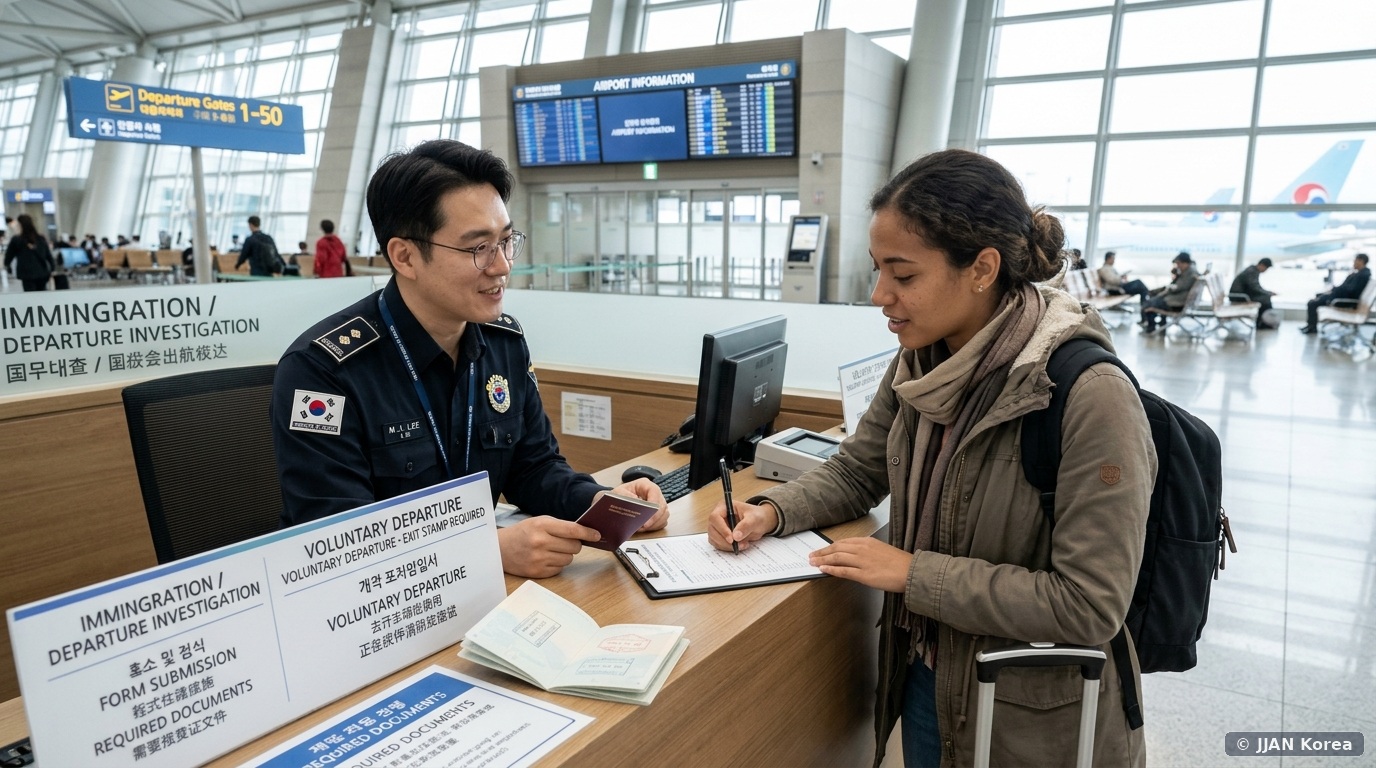
In an ongoing effort to balance rigorous national border enforcement with humanitarian legal remedies, the Republic of Korea Ministry of Justice (MOJ), in coordination with the National Police Agency and Ministry of Employment and Labor, conducts periodic nationwide joint crackdowns on unauthorized stay. Simultaneously, authorities institute the Voluntary Departure Special Scheme (자진출국 사전신고제)—a vital legal window allowing foreign nationals residing unlawfully in South Korea to depart voluntarily with substantial administrative relief.
For undocumented individuals, visa overstayers, or workers whose legal status lapsed following an unauthorized workplace departure, the consequences of apprehension during an immigration enforcement raid are devastating: immediate handcuffed detention at a foreigner detention center (외국인보호소), forced deportation (강제퇴거), administrative fines reaching up to 30,000,000 KRW, and punitive entry bans (입국규제) ranging from 5 to 10 years. In stark contrast, taking advantage of the official Voluntary Departure Scheme provides complete exemption from entry bans and deferred or waived administrative fines. Below is the authoritative legal walkthrough to navigating voluntary departure, completing the mandatory 3-day advance declaration, managing financial assets, handling lost passports, understanding re-entry rights, and departing South Korea with dignity.
1. Legal Benefits: Apprehension vs. Voluntary Departure
The differences in legal standing between being detained during an enforcement sweep and reporting under the Voluntary Departure Scheme are immense under Article 59 and Article 68 of the Immigration Act:
| Legal Consideration | Arrested in Immigration Crackdown | Voluntary Departure Scheme (자진출국) |
|---|---|---|
| Immediate Detention Status | Mandatory detention at Hwaseong or Cheongju Center | Zero detention; remain free until scheduled flight |
| Entry Ban Duration (입국규제) | 5 to 10-year strict ban from entering Korea | Complete waiver or suspension of entry ban |
| Administrative Fine (과태료) | Full assessment up to 30,000,000 KRW | Exempt or deferred under policy guidelines |
| Future Visa Reapplication | Nearly 100% rejection rate at Korean embassies | Eligible to apply for valid visas (e.g., C-3, E-9, D-2) |
2. Real-World Scenarios: 3 Case Studies of Voluntary Departure
To understand how this policy applies across diverse situations, consider three common real-world examples:
Scenario A: An Overstayed Tourist (C-3 Visa Overstay of 8 Months)
Elena arrived on a 90-day tourist visa and remained in Korea without status for 8 months. Had she been arrested during a subway station sweep, she would have faced immediate transfer to the Hwaseong Foreigner Detention Center, a 5-year entry ban, and an administrative fine of 4,000,000 KRW. Instead, Elena booked a flight home, completed the HiKorea advance declaration 5 days before departure, and presented herself at Incheon Airport. Immigration waived the entry ban and issued an exit stamp without detention, leaving her record clear for legitimate future travel.
Scenario B: An E-9 Worker Who Left Their Registered Workplace
Thura arrived under the Employment Permit System but left his factory due to unpaid wages without obtaining an authorized Workplace Transfer. Overstaying for 18 months made him undocumented. By reporting under the Voluntary Departure Scheme, Thura claimed his accumulated Departure Guarantee Insurance and Severance Pay at Incheon Airport in cash, avoided criminal charges, and preserved his legal right to retake the EPS-TOPIK Korean exam in his home country.
Scenario C: A University Student Whose D-2 Visa Lapsed
Jin was an undergraduate student who took a leave of absence but failed to depart within the statutory 30-day window due to family illness abroad. Reporting under the voluntary scheme allowed Jin to exit cleanly, obtain an official Certificate of Voluntary Departure, and successfully apply for a re-entry student visa at the Korean consulate in his home country for the subsequent academic term.
3. What If Your Passport Is Expired or Lost? (Consular Emergency Certificates)
A frequent dilemma faced by undocumented foreign residents is an expired, damaged, or lost passport. Under South Korean immigration law, you cannot board an international flight or exit the country without a valid travel document. However, an expired passport does not prevent you from using the Voluntary Departure Scheme:
- Visit Your National Embassy in Seoul: Book an appointment with your country’s embassy in Seoul (located primarily in Yongsan-gu, Itaewon, or Jung-gu). Present your national birth certificate, expired passport copy, and identification.
- Obtain an Emergency Travel Certificate (여행증명서 / Emergency Certificate): Consular offices issue single-journey Emergency Travel Certificates specifically designed for repatriation. This document is recognized by both South Korean immigration and international airlines as a valid passport replacement.
- Submit Pre-Reporting with Emergency Certificate: Once the Emergency Certificate is issued, use its official serial number to complete your HiKorea 3-day advance declaration. Immigration investigation officers at Incheon Airport accept this document alongside your flight boarding pass without penalty.
4. Mandatory 3-Day Pre-Reporting System (자진출국 사전신고제)
You cannot simply purchase an airline ticket and arrive at the airport expecting voluntary departure processing. To prevent individuals facing criminal indictments or police investigations from fleeing the jurisdiction, the Ministry of Justice enforces the Mandatory Pre-Reporting Mandate:
The Statutory Timing Window
Every individual departing voluntarily must submit their formal notice between 3 business days and 15 days prior to the scheduled flight departure date (excluding weekends and statutory public holidays). For example, if your flight departs on a Friday, your pre-declaration must be submitted no later than Tuesday.
Two Submission Pathways:
- Online Pre-Reporting via HiKorea (
hikorea.go.kr): Visit the HiKorea portal and select “Advance Declaration of Voluntary Departure (자진출국 사전신고)”. Enter your passport details, departure date, flight number, and airport. Upload scanned copies of your passport biographical page and valid airline flight booking confirmation. - In-Person at Regional Immigration Offices: Visit the investigation division (조사과) of the immigration office governing your residence during business hours with your passport and flight ticket.
5. Step-by-Step Airport Departure Day Procedure
On your confirmed departure day, arrive at Incheon International Airport (or Gimhae/Jeju Airport) at least 4 to 5 hours prior to your scheduled flight to complete final administrative clearance:
Step 1: Check In at Airline Counter
Present your passport at your airline check-in counter and collect your physical boarding pass. Baggage can be checked in as normal.
Step 2: Visit Airport Immigration Investigation Division (출입국 출국조사계)
Before proceeding through security screening, locate the airport immigration office (Incheon Airport Terminal 1, 3rd Floor near Check-in Counter G, or Terminal 2, 2nd Floor). Submit your:
- Original valid passport or Consular Emergency Travel Certificate.
- Physical flight boarding pass.
- Printed Advance Notice Confirmation of Voluntary Departure (자진출국 사전신고 접수증).
Step 3: Verification & Official Departure Stamp
An immigration investigation officer cross-references your criminal record and immigration history. Once cleared, the officer affixes an official exit verification stamp (출국심사 확인인) into your passport and registers your departure under the voluntary compliance code. You can now pass through security screening, collect any remaining Departure Guarantee Insurance Payouts at Airport Banking Booths, and board your flight with peace of mind.
6. Managing Bank Accounts, Housing Deposits & Unpaid Wages Before Leaving
Departing voluntarily does not mean you must forfeit your hard-earned financial assets in South Korea:
- Housing Security Deposits (보증금): Coordinate with your landlord in advance. As detailed in our Korea Housing & Deposit Protection Guide, return apartment keys on move-out day and have your deposit transferred directly to your bank account before arriving at the airport.
- Korean Bank Accounts & International Wire: Ensure your mobile banking certificate is active. You can wire accumulated funds to your home country bank account using authorized foreign exchange apps or visit a bank branch before departure. Accounts with clean standing remain accessible abroad for receiving final settlements.
- Unpaid Wages Claims: If your employer owes you back wages, you can still file a petition with the Ministry of Employment and Labor before leaving, or authorize a labor attorney (노무사) via power of attorney to collect funds and wire them overseas.
7. Legal Nuances: Deportation Order vs. Departure Order vs. Voluntary Exit
Immigration law draws sharp distinctions between different exit modalities:
- Forced Deportation (강제퇴거 / Article 46): Issued when caught during crackdowns. Involves physical escort by immigration officers to the aircraft door, immediate blacklisting on INTERPOL and Korean border databases, and a 5 to 10-year absolute entry ban.
- Departure Order (출국명령 / Article 68): Issued to foreigners who committed minor administrative violations (such as failing to renew an ARC). Granted a 14-day window to leave voluntarily at their own expense; carries a 1 to 2-year entry ban.
- Voluntary Departure (자진출국): Initiated entirely by the foreign resident before being caught. Carries zero entry ban and preserves clean civil records.
8. Frequently Asked Questions (FAQ)
Q1. Who is strictly EXCLUDED from the Voluntary Departure Scheme benefits?
Under MOJ directives, individuals who have committed violent criminal offenses (assault, drug trafficking, sexual misconduct, financial fraud/voice phishing, or severe traffic injuries) are strictly disqualified. Criminal suspects facing travel bans (출국정지) will be taken into police custody upon reporting.
Q2. Can I collect my Departure Guarantee Insurance (출국만기보험) if I leave voluntarily?
Yes. If you previously worked under an E-9 or H-2 visa and completed 1 year of continuous service before becoming undocumented, you remain legally entitled to claim your accumulated departure guarantee insurance and severance pay. Contact Samsung Fire Foreign Worker Center to arrange airport cash pickup or overseas bank transfer.
Q3. When can I re-enter South Korea after voluntary departure?
Unlike deported individuals who face mandatory 5-year entry bans, voluntary departures do not incur automatic statutory bans. However, consular officers evaluate your stability and domestic ties. While tourist visas (C-3) may require time, individuals who voluntarily departed frequently return legally via employment programs (EPS E-9), student visas (D-2), or investment visas once legitimate eligibility is demonstrated.
Q4. Will immigration arrest me when I visit the office to report voluntarily?
No. The entire statutory purpose of the Voluntary Departure Scheme is to encourage peaceful compliance. Provided you have a valid departure flight ticket and are not wanted for severe criminal offenses, officers facilitate your pre-declaration without detention.
JJAN Korea Policy & Legal Verification Desk
Regulatory Reference: Immigration Act (출입국관리법) Article 59 (Execution of Departure Orders), Article 68 (Departure Orders), and Ministry of Justice Korea Immigration Service Directive No. 2026-44.
Verification Authority: Republic of Korea Ministry of Justice (법무부) & Korea Immigration Service Airport Border Control Division.