
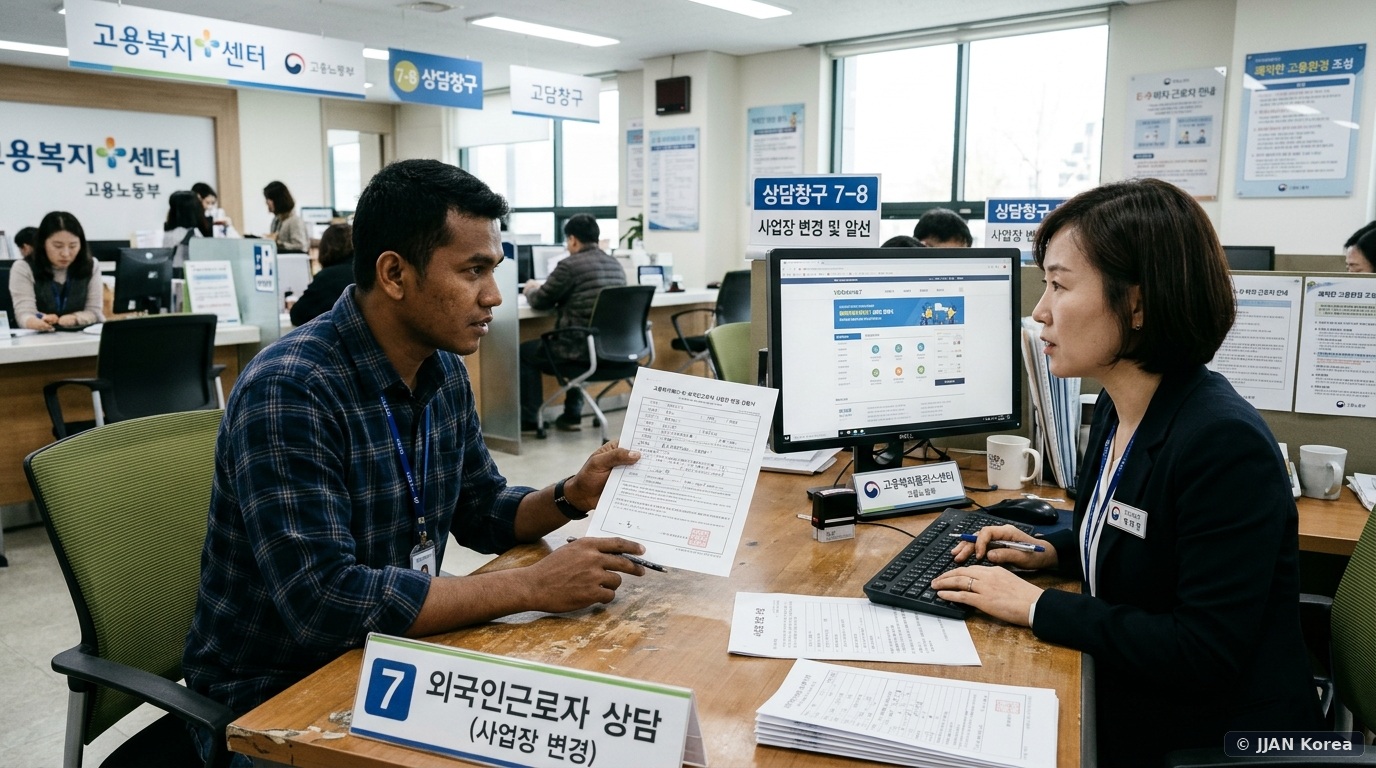
Under the Republic of Korea’s Employment Permit System (EPS / 고용허가제), foreign workers holding E-9 (Non-professional Employment) visas power critical sectors across manufacturing, construction, agriculture, livestock, and coastal fisheries. Historically, one of the most contentious aspects of the EPS framework has been the legal mechanism governing the Workplace Transfer (사업장 변경)—the statutory process by which an immigrant worker changes employers.
While South Korean immigration and labor laws generally obligate E-9 employees to complete their contract with their designated employer, Article 25 of the Act on the Employment of Foreign Workers (외국인근로자의 고용 등에 관한 법률) explicitly guarantees the legal right to transfer when the employer commits labor violations, defaults on wages, provides substandard living conditions, or subjects workers to unfair treatment. More importantly, when an employer is at fault, the transfer does NOT count toward the worker’s statutory transfer limit. Below is the comprehensive legal guide to identifying authorized grounds for transfer, collecting evidence, navigating the 3-month job search window at regional Job Centers (고용복지플러스센터), and defending your legal status in South Korea.
1. The Statutory Grounds: When Can an E-9 Worker Legally Transfer?
Under Article 25, Paragraph 1 of the Act on the Employment of Foreign Workers, an E-9 worker may apply for a change of workplace under six distinct statutory categories:
| Statutory Transfer Grounds | Legal Threshold & Criteria | Impact on Worker’s Transfer Quota |
|---|---|---|
| Mutual Contract Termination / Expiration | Contract term ends, or employer agrees in writing to release worker. | Counts toward standard limit (up to 3 times in 3 years). |
| Unpaid Wages / Wage Delinquency | Wages delayed by 2+ months, or 30%+ delayed for 2 consecutive months. | Exempt from quota (Does NOT count against worker). |
| Business Closure / Bankruptcy / Suspension | Factory shuts down, loses business license, or halts production. | Exempt from quota (Does NOT count against worker). |
| Physical / Verbal Abuse or Sexual Harassment | Assault, severe insults, racial slurs, or sexual misconduct by management. | Exempt from quota (Emergency transfer authorized). |
| Substandard / Unlawful Housing Facilities | Makeshift vinyl greenhouse barracks or unpermitted modular units. | Exempt from quota (Does NOT count against worker). |
| Severe Occupational Injury / Health Risk | Worker injured on the job and unable to perform original heavy duties. | Exempt from quota (Assigned to lighter work sector). |
Standard Quota vs. Exempt Transfers: In ordinary circumstances where an employer voluntarily releases a worker, an E-9 employee may transfer workplaces up to 3 times during their initial 3-year stay, and up to 2 times during their 1-year and 10-month re-employment extension (total 5 times). However, when the transfer is caused by employer fault (wage theft, violence, illegal housing), it is classified as an Exempt Transfer (사업주 귀책사유) and leaves your transfer count completely untouched.
2. Regional Movement Restrictions & The 2026 Zone Rule
Foreign workers must be mindful of geographic zoning regulations. Under recent Ministry of Employment and Labor policy directives, E-9 workers in manufacturing and agriculture are generally expected to search for new employment within their initial regional labor market zone (권역 제한) (e.g., Greater Seoul / Gyeonggi-do, Chungcheong region, Honam region, Yeongnam region). However, exceptions apply:
- Inter-Regional Transfers Authorized for Employer Fault: If your transfer is approved due to employer violations (such as assault or severe wage delinquency), the regional restriction is waived, permitting you to seek employment in any province nationwide.
- Industry Sector Preservation: Transfers must remain within your original visa sector (e.g., manufacturing workers must remain in manufacturing; agricultural workers must remain in agriculture).
3. The Critical 3-Month Job Search Window (구직기간)
Timing is everything in workplace transfer proceedings. Under Article 25, Paragraph 3 of the Act on the Employment of Foreign Workers, an E-9 worker must adhere to two strict statutory countdowns:
- Application Deadline (1 Month): You must report to the local Employment Welfare Plus Center (고용센터) and file your Application for Change of Workplace (사업장변경신청서) within 1 month from the date of contract termination.
- Job Search Window (3 Months): Once registered, you have a statutory window of 3 months (90 days) to secure an approved employment contract with a new business. If you fail to secure a contract within 3 months, your E-9 visa is automatically cancelled, and you must depart South Korea.
Statutory Extension for Industrial Injuries: If you are undergoing medical treatment for a workplace injury, the 3-month clock is legally frozen under our analyzed Sanjae Industrial Accident Protections until medical rehabilitation concludes.
4. The Legal Burden of Proof: Documenting Unlawful Workplace Conditions
In workplace transfer disputes, the foreign worker bears the initial burden of presenting credible evidence demonstrating employer fault. Under South Korean administrative law, verbal claims alone are insufficient. Workers should proactively assemble objective documentation:
- Audio Recordings under Korean Wiretap Law: Under the Protection of Communications Secrets Act (통신비밀보호법), recording a conversation in which you are an active participant is 100% legal without the other party’s consent. If a factory supervisor yells verbal abuse, threatens visa cancellation, or demands illegal fees, keep your phone recording. These audio files serve as decisive legal evidence before labor inspectors.
- Financial Bank Records: Retain printed bank passbook statements documenting the exact dates and amounts deposited by your employer. A gap of 60 consecutive days proves statutory wage delinquency under MOEL criteria.
- Photographic and Video Evidence: Capture clear photos of workplace hazards, unguarded industrial machinery, lack of emergency exits, or substandard living conditions (such as unheated shipping containers or broken plumbing).
- Hospital Injury Certificates: If an injury occurs or stress causes severe health deterioration, visit a physician immediately and request an official Medical Certificate (진단서) explicitly stating the recommended period of rest.
5. Defending Against Malicious ‘Runaway’ Reports (이탈신고 대응 및 구제 절차)
One of the most abusive tactics employed by unscrupulous employers is filing a false Runaway Report (이탈신고 / Departure without Permission) with immigration authorities when a worker requests a transfer or leaves an abusive workplace. Under Article 17 of the Immigration Act, if an employer files a runaway report, the worker’s status is flagged for immediate arrest and deportation.
How to Neutralize a False Runaway Report:
- File Your Dispute First: On the very day you leave the workplace, report immediately to the local Employment Center (고용센터) or Ministry of Employment and Labor (고용노동부) to file a formal labor petition or transfer request. The official registration number (민원접수증) proves you did not abscond, but are actively exercising statutory rights.
- Submit an Objection to Immigration: If the employer already filed an unauthorized leave notice, visit the immigration office investigation division with your labor dispute receipt and request a Temporary Stay Suspension (이탈신고 처리 보류) pending the labor board’s final verdict. Immigration officers will freeze deportation procedures while the labor investigation proceeds.
6. Step-by-Step Procedure: Filing for Transfer at the Job Center
To execute a workplace transfer smoothly, follow these verified administrative steps:
Step 1: Gather Objective Evidence
If leaving due to employer fault, compile concrete proof: bank transfer records showing delayed wages, photos or videos of substandard dormitories, medical injury certificates, audio recordings of verbal abuse, or police reports (사건사고사실확인원).
Step 2: Submit Application to Local Employment Center (고용센터)
Visit the regional Employment Welfare Plus Center (고용복지플러스센터) holding jurisdiction over your existing workplace. Submit your:
- Application for Workplace Change (사업장변경신청서).
- Valid Alien Registration Card (ARC) and passport.
- Standard Employment Contract (표준근로계약서).
- Proof of employer fault or signed release letter from the employer (이적동의서).
Step 3: Job Matching via EPS Job Brokerage System
The Job Center enters your profile into the official EPS foreign labor matching database. Registered Korean employers with foreign worker permits review candidates and schedule interviews. The Job Center sends SMS alerts regarding job openings. You can also actively contact eligible companies seeking workers in your sector.
Step 4: Sign New Contract & Immigration Approval
Upon reaching an agreement, sign a new Standard Employment Contract at the Job Center. The center issues an official Employment Permit Certificate (고용허가서). Finally, report your change of workplace to the regional Immigration Office within 14 days to update your legal stay.
5. Frequently Asked Questions (FAQ)
Q1. Can an employer legally charge me money to sign a release letter (이적동의서)?
No. Demanding money, broker fees, or “release payments” from a foreign worker is strictly criminal under Article 19 of the Act on the Employment of Foreign Workers. Any employer demanding money faces severe criminal penalties and total disqualification from hiring foreign workers.
Q2. Can I switch from agriculture (농축산업) to manufacturing (제조업)?
Generally, no. Under EPS regulations, workers are legally restricted to transferring within their original designated industry sector (e.g., manufacturing to manufacturing, agriculture to agriculture). Sectoral crossover is only permitted under very rare special government exemption decrees.
Q3. What happens if my employer reports me as a runaway (이탈자) while I am applying for transfer?
If you leave a workplace without employer consent, some employers retaliate by filing an unauthorized leave report (이탈신고) with immigration. To protect yourself, visit the Job Center immediately on the day you leave to register your labor dispute. A registered dispute blocks runaway status and protects your visa legality.
Q4. Which organization provides free labor mediation for workplace transfers?
You can contact the Korea Support Center for Foreign Workers at 1644-0644 or the Ministry of Employment and Labor Foreign Language Help Desk at 1350 for multilingual counseling and labor inspector mediation.
JJAN Korea Policy & Legal Verification Desk
Regulatory Reference: Act on the Employment of Foreign Workers (외국인근로자의 고용 등에 관한 법률) Article 25 (Change of Business or Workplace), Enforcement Decree Article 30, and Labor Standards Act Article 23.
Verification Authority: Republic of Korea Ministry of Employment and Labor (고용노동부) & HRD Korea.