As South Korea enters the height of summer, agricultural farms, rural greenhouses, and coastal fisheries across Gyeongsang-do, Jeolla-do, Chungcheong-do, and Gangwon-do rely heavily on the E-8 Seasonal Worker Visa (계절근로자) program. Authorized under bilateral Memorandums of Understanding (MOUs) negotiated between Korean municipal county governments and partner nations (such as Vietnam, the Philippines, Cambodia, Laos, and Mongolia), E-8 workers provide indispensable labor during peak agricultural harvest seasons. However, the combination of intense summer heatwaves and rural geographic isolation creates unique occupational and legal vulnerabilities.
Under the Occupational Safety and Health Act (산업안전보건법) and Ministry of Employment and Labor (MOEL) seasonal worker directives, agricultural employers are bound by strict statutory mandates: mandatory heatwave rest intervals, absolute bans on substandard container accommodations, direct wage deposit protections, and universal industrial accident insurance. Failing to uphold these standards triggers severe sanctions, including immediate revocation of foreign worker allocation quotas for farming households and municipal blacklisting. Below is the comprehensive legal guide to seasonal worker rights in South Korea, heatwave safety protocols, housing compliance standards, labor law exemptions, and emergency dispute hotlines.
1. The 2026 Heatwave Occupational Safety Standard (폭염 산재 예방 3대 기본수칙)
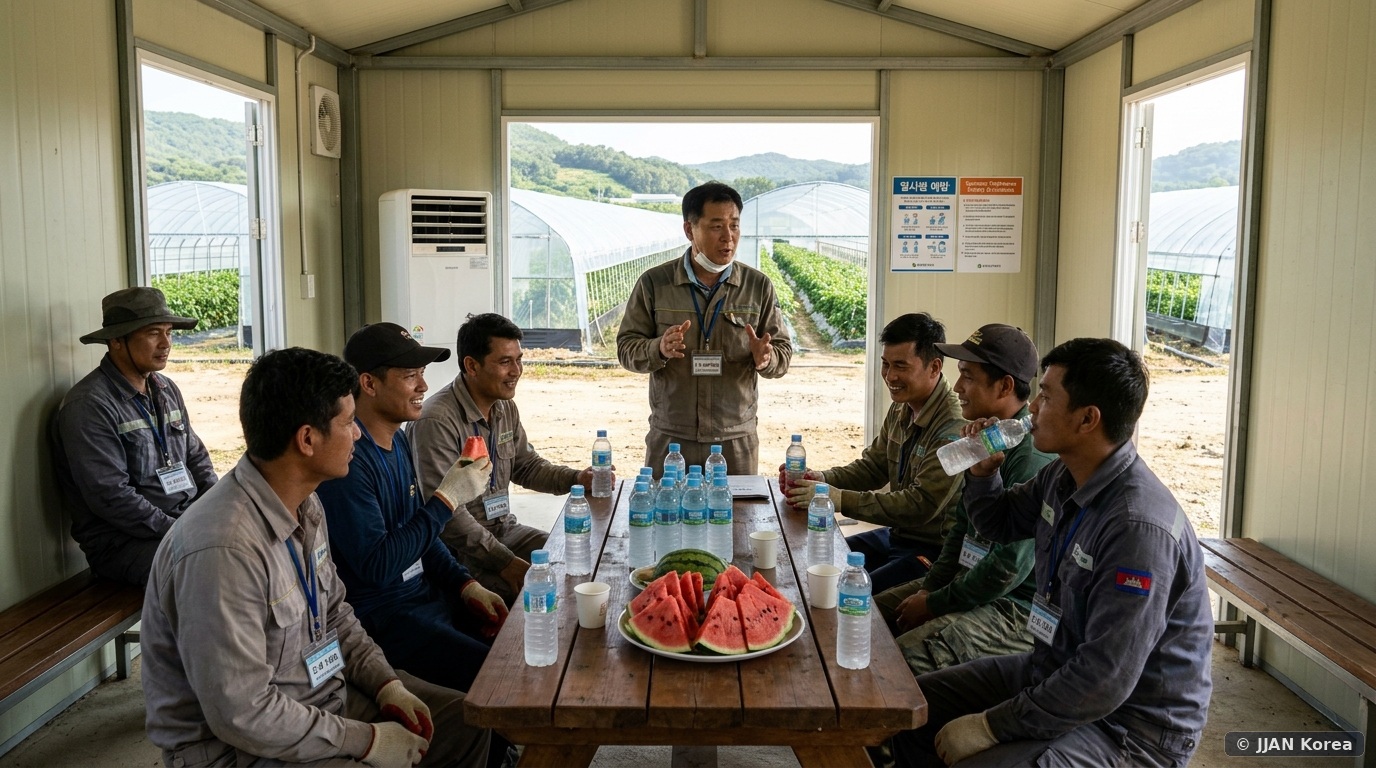
Summer temperatures inside agricultural vinyl greenhouses frequently exceed 40°C (104°F) with extreme humidity, creating severe risks of heatstroke, heat exhaustion, and fatal occupational collapse. Under Article 39 of the Occupational Safety and Health Act, employers must strictly observe the Three Basic Heatwave Safety Rules (물·그늘·휴식 / Water, Shade, Rest):
| Heat Warning Level & Index | Statutory Rest Interval Mandate | Mandatory Workplace Facilities |
|---|---|---|
| Heat Wave Advisory (폭염주의보, 33°C+) | 10 minutes of rest every 1 hour of labor | Shaded rest shelter, cool clean drinking water, salt tablets. |
| Heat Wave Warning (폭염경보, 35°C+) | 15 minutes of rest every 1 hour of labor | Air-conditioned indoor rest area; stop work between 14:00–17:00. |
| Extreme Heat Emergency (38°C+) | Total suspension of outdoor greenhouse labor | Shift adjustment to early morning (05:00–10:00) with full pay. |
Right to Suspend Work (작업중지권): Under Article 52 of the Occupational Safety and Health Act, an employee who senses an imminent danger to their health—such as dizziness, rapid heart rate, or nausea from extreme heat—has the statutory right to immediately suspend work, move to a cool area, and notify management without facing retaliatory wage cuts or dismissal.
2. Strict Accommodation Standards & Prohibition of Vinyl Greenhouse Barracks
Historically, some rural farms housed seasonal workers in makeshift shipping containers or substandard tents erected directly inside vinyl greenhouses (비닐하우스 내 가설건축물), where thermal radiation creates lethal conditions. In response, the Ministry of Agriculture, Food and Rural Affairs (MAFRA) and the Ministry of Justice enacted an absolute, zero-tolerance policy:
Mandatory Housing Requirements:
- Prohibition of Temporary Structures inside Greenhouses: Housing seasonal workers inside greenhouses is strictly banned. Any farm violating this rule loses its foreign worker quota for 3 years, and workers are immediately reassigned to another farm.
- Legitimate Residential Housing: Employers must provide detached houses, apartments, officetels, or officially permitted modular housing units equipped with air conditioning, heating systems, smoke detectors, fire extinguishers, secure locks, and clean indoor plumbing with hot water.
- Statutory Dormitory Fee Ceilings: As established in our Korea Minimum Wage & Deduction Protections Guide, employers cannot charge exorbitant dormitory fees. Monthly accommodation deductions for compliant rural housing are strictly capped between 8% and 15% of basic salary, and require signed bilingual deduction agreements.
3. Labor Standards Act Article 63: Agricultural Exceptions and Worker Rights
One of the most complex legal realities confronting E-8 workers is the statutory framework of Article 63 of the Korean Labor Standards Act (근로기준법 제63조). Under South Korean law, agricultural and livestock businesses are exempt from standard statutory overtime, night work, and holiday work premium multipliers due to the seasonal, weather-dependent nature of farming:
- What is Exempt: Agricultural employers are not legally obligated to pay the standard 1.5x overtime multiplier or 2.0x holiday multiplier for hours worked past 8 hours daily.
- What REMAINS Mandatory: Employers MUST pay 100% of the statutory hourly minimum wage (10,030 KRW in 2026) for every actual hour worked. If a worker completes 10 hours in a day, they must receive
10 hours × 10,030 KRW = 100,300 KRW. Furthermore, mandatory Weekly Paid Holidays (주휴일) and paid rest days must still be honored under contractual agreements.
4. Wage Protection: Mandatory Direct Bank Transfers
Cash wage payments are illegal under municipal E-8 program operating guidelines. To prevent wage theft, unlawful broker fees, or unauthorized intermediate deductions:
- Direct Deposit Mandate: The hiring farm must transfer wages directly into the foreign worker’s verified Korean Bank Account. Hand-to-hand cash payments are prohibited.
- Statutory Minimum Wage Baseline: In 2026, seasonal agricultural workers must receive no less than 10,030 KRW per hour (or 2,096,270 KRW monthly base pay).
- Itemized Wage Slips (급여명세서): The farmer must provide an itemized written or electronic pay slip detailing the number of working days, overtime hours, and any permitted tax or room/board deductions.
5. Real-World Case Study: Transferring Away from an Unsafe Farm
Consider the case of Somchai and Khem, two E-8 seasonal workers assigned to a strawberry cultivation farm in Chungcheongnam-do. During July, daytime temperatures inside the greenhouses reached 42°C. The farm supervisor refused to provide drinking water and demanded 12-hour continuous shifts without rest breaks. Furthermore, the workers were housed in an uninsulated container with a broken fan. Somchai documented the conditions via smartphone photos and contacted the regional Foreign Worker Counseling Center.
The county agriculture department and labor board conducted an immediate unannounced inspection. The authorities ruled that the farm committed severe violations of heatwave safety protocols and housing standards. Within 4 business days, both workers were transferred to a modern hydroponic farm with air-conditioned dormitories and strict 8-hour shift limits. The original farm was barred from receiving foreign workers for 3 years, demonstrating the strength of Korean administrative enforcement when violations are reported.
6. Illegal Broker Fraud Prevention & Sister City Recruitment Transparency
One of the primary legal protections instituted by the Ministry of Justice is the elimination of predatory private brokers in the E-8 recruitment pipeline. Under government-to-government (G2G) Memorandums of Understanding, seasonal worker selection is conducted strictly between Korean municipal county governments (시청·군청) and partner foreign local governments. No private employment agency, recruitment broker, or travel intermediary is legally authorized to charge placement fees.
If an overseas broker demands “visa processing fees” or “security deposits” of several thousand dollars, this constitutes criminal fraud under both South Korean and foreign labor laws. E-8 candidates should only pay legitimate passport, visa application, and standard airline ticket costs directly to authorized authorities.
7. Agricultural Pesticide Safety & Mandatory Protective Equipment
Rural agricultural labor frequently involves pesticide and fungicide spraying to protect crops. Under Article 38 of the Occupational Safety and Health Act, farmers are legally obligated to provide certified personal protective equipment (PPE)—including chemical-resistant respirators, safety goggles, protective gloves, and waterproof aprons—free of charge. Workers cannot be compelled to spray toxic agricultural chemicals without proper safety gear. If an employer fails to provide certified PPE, workers can file an immediate complaint with the local labor office.
8. Emergency Medical Treatment & Industrial Accident Insurance (산재보험)
Every seasonal worker is legally enrolled in Industrial Accident Compensation Insurance (산재보험). If a worker collapses from heatstroke or suffers a farm machinery injury, they are entitled to full medical coverage as detailed in our Sanjae Industrial Accident Insurance Guide. Calling 119 emergency services is completely free, and paramedics provide interpretation support.
7. Crucial Documentation Checklist for Seasonal Workers
- Standard E-8 Labor Contract (표준계약서): Listing approved farm location, working hours, and monthly salary.
- Alien Registration Card (ARC): Verifying seasonal stay validity (typically 5 to 8 months).
- Korean Bank Passbook & Debit Card: Ensuring personal control over financial transactions.
- Emergency Contact Card: Contact details for the local county office (군청/시청) seasonal worker officer and home country consular liaison.
8. Frequently Asked Questions (FAQ)
Q1. Can an E-8 seasonal worker change farms if the employer mistreats them?
Yes. If the employer fails to pay wages, provides illegal greenhouse housing, or subjects workers to verbal/physical abuse, the worker can report the violation to the local county office (군청 농업축산과) or Ministry of Employment and Labor. The local government will facilitate a transfer to another registered farm without loss of visa status.
Q2. Can an E-8 seasonal worker extend their stay beyond the original contract?
Under revised immigration guidelines, seasonal workers can extend their stay up to a maximum total duration of 8 months (an initial 5 months plus an authorized 3-month extension) upon mutual agreement with the employer and local government approval.
Q3. What should I do if a farm supervisor withholds my passport or ARC?
Withholding a foreign worker’s passport or Alien Registration Card is a severe criminal offense under Article 33-2 of the Immigration Act, punishable by up to 3 years imprisonment or 30,000,000 KRW in fines. You should report this immediately to the police (112) or the Ministry of Justice Foreigner Hotline (1345).
Q4. Which phone numbers provide multilingual assistance for rural farm workers?
Workers can call the Ministry of Justice Immigration Contact Center at 1345 (available in 20 languages) or the Korea Support Center for Foreign Workers at 1644-0644 for counseling and labor mediation.
JJAN Korea Policy & Legal Verification Desk
Regulatory Reference: Occupational Safety and Health Act (산업안전보건법) Articles 39 & 52, Labor Standards Act Article 63, Immigration Act Article 33-2, and Ministry of Agriculture, Food and Rural Affairs (MAFRA) E-8 Seasonal Worker Operation Guidelines.
Verification Authority: Republic of Korea Ministry of Employment and Labor (고용노동부) & Ministry of Agriculture, Food and Rural Affairs.