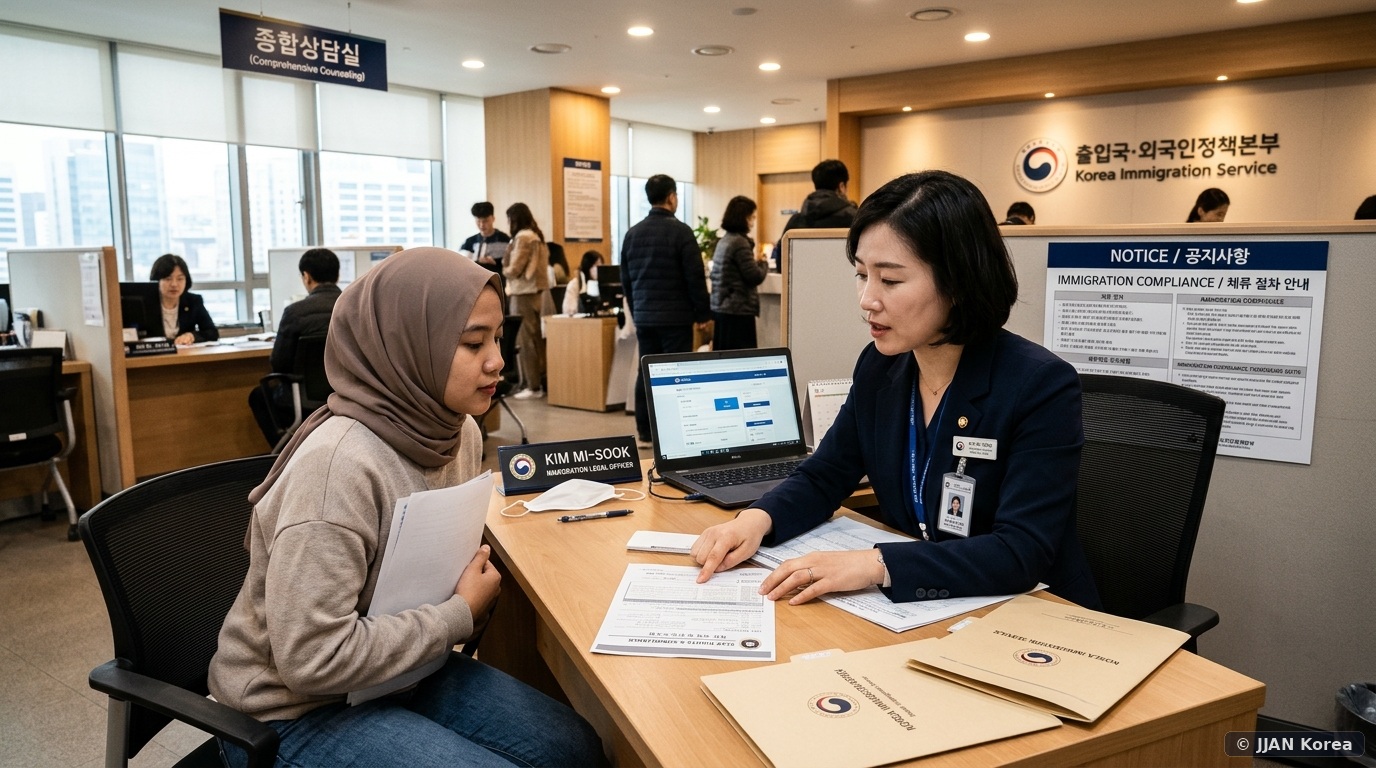
On October 26, 2026, the Republic of Korea Ministry of Justice (MOJ), in formal coordination with the National Police Agency (NPA), the Ministry of Employment and Labor (MOEL), the Korea Coast Guard (KCG), and the Ministry of Land, Infrastructure and Transport (MOLIT), officially announced the nationwide commencement of the Autumn 2026 Second Joint Government Crackdown on Illegal Stay and Unlawful Employment (2026년 하반기 정부합동 불법체류 단속). Scheduled to run through December, this inter-agency campaign represents the South Korean administration’s most technologically integrated enforcement blitz to date.
Operating under the Next-Day Media Reporting Rule (D+1 Principle), JJAN Korea delivers this comprehensive, field-tested legal compliance guide for foreign tourists, international students, and resident workers across South Korea. While the primary objective of the joint crackdown is targeting illegal broker rings, unauthorized manufacturing employment, and unlicensed delivery gig networks, lawful foreign residents frequently find themselves caught in aggressive workplace inspections, subway transit spot checks, and neighborhood audits. Below is the essential legal analysis of enforcement scopes, statutory search limits, mandatory document carriage rules, constitutional human rights protections, and the vital Notification Duty Exemption Rule (통보의무 면제제도) that shields injured or victimized workers from deportation.
1. Scope & Priorities of the Autumn 2026 Joint Crackdown
Unlike standard immigration desk reviews, the joint enforcement task force mobilizes police patrol units, labor inspectors, and immigration enforcement officers conducting coordinated on-site raids. The official government notice highlights five high-priority enforcement sectors:
| Target Sector & Activity | Enforcement Method & Agency | Legal Consequences & Penalties |
|---|---|---|
| Illegal Labor Brokers & Syndicate Rings | Police Criminal Investigation & Digital Forensics | Arrest warrants, criminal trials, and asset confiscation. |
| Unauthorized Delivery & Logistics Gig Work | MOLIT & Traffic Police Joint Street Checks | Immediate revocation of student/tourist visas and exit orders. |
| Entertainment, Nightlife & Hostess Bars | Nighttime Joint Raids by MOJ & Police | Forced deportation and 5 to 10-year entry bans. |
| Industrial Construction Sites & Subcontractors | MOEL Labor Inspectors & Immigration Taskforce | Severe employer fines (up to 30M KRW) and worker detention. |
| Lawful Foreigners Without Physical ARC | Immigration Field Identity Checks | Administrative fines under Immigration Act Art. 27 (up to 1M KRW). |
Heightened Technological Tracking: The 2026 crackdown utilizes integrated real-time mobile database terminals, allowing enforcement officers to scan QR codes and foreign registration numbers instantly on the street to verify visa validity, address registration, and authorized workplace codes.
2. Mandatory Document Carriage: Immigration Act Article 27
One of the most frequently violated provisions by tourists, expats, and foreign exchange students is Article 27 of the Immigration Act (Carrying and Presenting Passports, etc.):
- The Statutory Mandate: Any foreigner residing or staying in the Republic of Korea must carry their passport, seaman’s certificate, Alien Registration Card (외국인등록증), or Foreign Resident Card at all times.
- Duty to Present: When an immigration control officer or judicial police officer requests document presentation while carrying out official duties, the foreigner must immediately produce their ID.
- Non-Compliance Penalty: Refusing or failing to present your valid registration document carries an administrative fine of up to 1,000,000 KRW under Article 98 of the Immigration Act, and officers may escort you to an immigration branch office for identity verification.
- Digital Alternative: Registered foreign residents who have activated the Mobile Foreign Resident Card (모바일 외국인등록증) via the Ministry of the Interior and Safety (MOIS) official government app can present the cryptographic digital card on their smartphone as a fully valid legal equivalent.
3. Enforcement Officers’ Statutory Limits: What They Can and Cannot Do
During workplace raids or spot checks, enforcement officers must operate strictly within constitutional due process and statutory administrative boundaries under the Immigration Act and the Criminal Procedure Code:
- Mandatory Identification: Before asking questions or requesting documents, officers must display their official identification badge and state their administrative agency and purpose of investigation. Plainclothes officers who refuse to show official credentials possess no legal authority to detain civilians.
- Workplace Entry vs. Private Quarters: Immigration officers may inspect public factory floors and business offices during operational hours. However, entering locked private residential dormitories (기숙사) or employee bedrooms requires a formal judicial search warrant issued by a district court judge, unless urgent emergency pursuit conditions are met.
- Physical Restraint Rules: Officers cannot use handcuffs, physical force, or protective restraints unless an individual actively resists lawful arrest, attempts violent escape, or threatens self-harm.
- Right to Translation & Representation: Detained foreigners have the statutory right to request an interpreter and contact their national embassy or legal counsel prior to signing any interrogation deposition.
4. The Human Rights Shield: Notification Duty Exemption Rule (통보의무 면제제도)
Perhaps the most critical legal protection in South Korean immigration jurisprudence is the Notification Duty Exemption Rule (통보의무 면제제도), established under Article 84 of the Immigration Act and Ministry of Justice Presidential Decree:
- General Principle: Normally, public officials (including police and civil servants) who discover an undocumented foreigner must immediately report them to immigration authorities for deportation.
- Statutory Exemption for Crime Victims & Patients: Under the exemption rule, public officials are strictly prohibited from reporting undocumented foreigners to immigration if the foreigner is:
- The victim of a violent crime, assault, theft, extortion, or sexual offense reporting to police.
- Filing an unpaid wage claim or labor standards violation with the Ministry of Employment and Labor as outlined in our Wage Theft Relief Guide.
- Seeking emergency medical treatment at a public hospital or applying for industrial accident compensation under our analyzed Sanjae Universal Coverage Guide.
- Safe Reporting: Undocumented foreigners who have suffered crimes or workplace abuse can safely report to the police or labor board without fear of immediate immigration arrest or summary deportation.
5. Emergency Legal Remedies: Challenging a Deportation Order (강제퇴거명령)
If a foreign national is apprehended and served with an official Deportation Order (강제퇴거명령서) or Departure Order (출국명령서), statutory legal remedies remain available through the South Korean judicial system:
Step 1: File a Formal Administrative Objection (이의신청)
Under Article 60 of the Immigration Act, a detained foreigner can submit a written Objection to the Minister of Justice (법무부장관 이의신청) within 7 days of receiving the deportation order through the chief of the immigration detention center. The Minister must review whether humanitarian grounds, family ties, or procedural defects justify cancelling the expulsion.
Step 2: File Administrative Lawsuit & Injunction (행정소송 및 집행정지)
If the administrative objection is rejected, the foreigner’s legal counsel can file a lawsuit with the Seoul Administrative Court to revoke the deportation order. Crucially, attorneys immediately file an Application for Stay of Execution (집행정지 신청). If the court grants the stay of execution, the government cannot deport the foreigner until the judicial trial reaches a final appellate verdict.
Step 3: Temporary Release from Detention (보호일시해제)
Under Article 65 of the Immigration Act, detained foreigners suffering from severe medical conditions, or those needing to settle domestic lease deposits and pending lawsuits, can apply for Temporary Release from Detention (보호일시해제) by depositing a security bond (up to 20,000,000 KRW). This allows the foreigner to live outside detention while resolving legal matters.
6. Crucial Field Checklist: How to Respond During an Immigration Check
- Carry Physical ID Daily: Always keep your Alien Registration Card, valid passport, or activated Mobile ARC in your wallet or smartphone.
- Remain Calm & Polite: Never run, physically resist, or present counterfeit documents. Present your ID calmly when requested.
- Verify Officer Credentials: Politely ask to see the officer’s official MOJ or NPA badge before answering questions.
- Do Not Sign Unchecked Korean Documents: Never sign a “Voluntary Departure Waiver” or Korean confession statement without fully understanding the translated text.
- Program Emergency Contact Numbers: Save the Immigration Contact Center (1345) and your embassy’s emergency hotline in your speed dial.
- Ensure Address Is Updated: Confirm your domicile was updated within 15 days of moving per our 15-Day Residence Reporting Guide to prevent accidental delinquency flags.
7. Frequently Asked Questions (FAQ)
Q1. Can police officers stop foreigners on the street purely based on appearance?
Under the Police Duties Execution Act (경찰관 직무집행법) Article 3, random stop-and-questioning (불심검문) requires reasonable grounds to suspect an individual has committed or is about to commit an offense. However, under Immigration Act Article 27, immigration officers possess broader statutory authority to request ID from foreigners in public spaces. Carrying valid documentation eliminates any grounds for extended detention.
Q2. If an international student is caught working without a permit, will they be deported immediately?
International students (D-2 / D-4) caught engaging in unauthorized part-time work without immigration permission as analyzed in our Student Work Permit Guide face tiered penalties: a first minor offense typically results in an administrative fine (통고처분 1M to 2M KRW) and a formal warning. Second offenses or working in prohibited sectors (such as delivery or nightlife) result in visa cancellation and a departure order.
Q3. What should an employer do if immigration conducts a surprise workplace raid?
Employers should verify enforcement badges, request a copy of the investigation notice, and verify that inspectors confine their search to authorized business facilities. Employers must ensure lawful foreign staff have ARC documents ready to prevent operational disruption.
Q4. Which emergency hotline provides free legal and translation assistance during detention?
Foreign residents can call the Ministry of Justice Immigration Contact Center at 1345 (available in 20 languages) or the Seoul Foreign Resident Center at 02-2229-4900 for emergency rights counseling.
JJAN Korea Policy & Legal Verification Desk
Regulatory Reference: Immigration Act (출입국관리법) Articles 27, 60, 65, 84 & 98, Police Duties Execution Act Article 3, and MOJ Joint Enforcement Guidelines 2026.
Verification Authority: Republic of Korea Ministry of Justice (법무부 출입국·외국인정책본부) & National Police Agency (경찰청).